Typical and Atypical Motor Development

Sugden and Wade, leading authors in this area, comprehensively cover motor development and motor impairment, drawing on sources in medicine and health-related studies, motor learning and developmental psychology.

A theme that runs through the book is that movement outcomes are a complex transaction of child resources, the context in which movement takes place, and the manner in which tasks are presented.

The core themes of the book involve descriptions of motor development from conception through to emerging adulthood, explanations of motor development from differing theoretical, empirical, and experiential perspectives, and descriptions and explanations of atypical motor development when the resources of the child are limited in some way.

Readership

Occupational therapists, physiotherapists, paediatricians, teachers (physical education, early childhood development, elementary education), educational psychologists, kinesiology and sports scientists.

Clinics in Developmental Medicine

Paediatric Orthotics

Orthoses are externally applied medical devices used to prevent or correct musculoskeletal deformities and improve physical functioning; these devices are typically custom made. This is one of very few books on the subject of orthotics published in recent years and the only book focusing solely on the orthotic management of children.

The first part of the book considers the principles that are fundamental to orthotic management, including a review of biomechanics, consideration of clinical assessment methods, and the materials and fabrication techniques used to make orthoses. The second part of the book comprises several condition-specific chapters that consider the appropariate orthotic management of the more common conditions in childhood in the context of multidisciplinary care. The chapters include neuromuscular conditions such as cerebral palsy, myelomeningocoele and muscular dystrophy; and also congenital deformities and conditions arising in childhood. One chapter considers orthotic intervention for idiopathic scoliosis and another considers the sometimes controversial issue of protective and corrective headwear. Whilst by no means exhaustive, Paediatric Orthotics provides both a basic grounding in the subject together with practical guidance to help clinical practice.

Paediatric Orthotics will be of use, not only to orthotists but also to physical and occupational therapists, paediatricians, paediatric orthopaedic surgeons and physiatrists. The book is also essential reading for all students and clinicians involved in the physical management of children with disabilities.

Clinics in Developmental Medicine No. 175
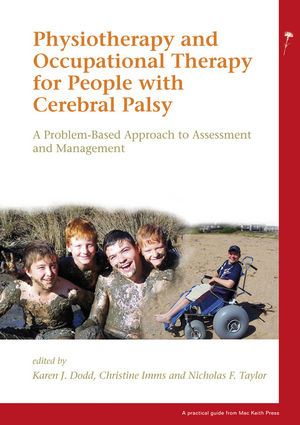
Physiotherapy and Occupational Therapy for People with Cerebral Palsy

Practical Guide

This book is a practical resource for physiotherapists and occupational therapists who support people with cerebral palsy, helping them to solve the problems with movement and other impairments that so often accompany cerebral palsy, so that they can be more active and better able to participate in roles such as study, work, recreation and relationships.

The first chapters provide the background to the clinical reasoning approach that informs the whole text, as well as an overview of therapeutic interventions.

The subsequent chapters present clinical situations that therapists will encounter in the course of their work with individuals with cerebral palsy across the lifespan.

Each chapter describes a case in detail, including the reasoning behind assessment and treatment choices, interventions and outcomes.

The themes emphasized throughout the book are the use of the clinical reasoning approach of the intervention process model, the International Classification of Functioning, Disability and Health as a framework to help therapists inform patient and family decision-making, family-centred approaches in developing and implementing therapeutic strategies, and multidisciplinary team work.

Postural Control

The complex nature of the postural control system makes it vulnerable to adverse conditions during early life, such as prenatally or perinatally acquired lesions of the brain or preterm birth. Children with disorders of the developing brain nearly always have dysfunctions in postural control. The postural control system of children with other neurodevelopmental disabilities such as myelomeningocele or muscle disease is also challenged: it has to find age-specific solutions for the postural problems posed by the disorder. These postural problems have serious consequences for the activities of daily life, as adequate postural control is a prerequisite for adequate motility. Until now, knowledge about the nature of postural problems in children has been scattered, and this has hampered the development of appropriate therapeutic management strategies. This book is a breakthrough in that it introduces the reader to the complexity of typical and atypical postural development and provides suggestions for the day-to-day management of postural problems in children with developmental disorders such as cerebral palsy, developmental coordination disorder, muscle disorder and myelomeningocoele. ‘This should be a “must read” for anyone whose occupation or interests are in the areas of motor development or rehabilitation.’ Diane Damiano

Clinics in Developmental Medicine No. 179

Neurophysiology and Neuropsychology of Motor Development

The central focus of this book is the development of skilled motor actions by children; commonplace but vital actions such as maintaining posture, walking, reaching and grasping, and manipulating objects and tools. It represents a state-of-the art report on motor development linking neurophysiological and neuropsychological approaches. Using examples from both normal and pathological development, contributions study pre and postnatal brain development and its relationship to movement, the importance of fetal movements, postural control in children, the neurobiology of locomotor development, neural mechanisms of grasping and typical patterns of behavioural change. New theoretical developments including adaptive model theory, dynamic systems theory, and the relationship between variability and stability in skill development are also critically reviewed.

Clinics in Developmental Medicine No. 143
Orthopaedic Management in Cerebral Palsy, 2nd Edition

Comprehensive review of current methods of management and evaluation of the motor disorders of cerebral palsy.

  • Features the whole range of orthopaedic surgical procedures with commentary on each
  • Reviews the current epidemiology in the subject, offering perspective on prevention
  • Provides tables of gross motor performance to assess the measure of effectiveness of physical therapy
  • Describes methods of management, including: assistive technology, selective posterior rootlet rhizotomy, Botulinum toxin intramuscular injections and intrathecal Baclofen.

Clinics in Developmental Medicine No. 173-4
Management of the Motor Disorders of Children with Cerebral Palsy

Since the first edition of this book was published in 1984 the intensive debates about the ‘correct’ method of treatment for children with cerebral palsy have been resolved and it is now possible to describe what is generally agreed to be the optimal approach. This entirely rewritten new edition describes the most up-to-date thinking, with two new editors from America and Australia reflecting the worldwide picture. Coverage includes the coordination of care and the management team; the types of cerebral palsy; assessment; goal-setting; learning and neural plasticity; global therapeutic approaches as well as more focused (topical) therapies; the mechanisms of deformity, its prevention and treatment; and the transition to adult life. This book details the advancement of the subject from 1984 to 2002.

Clinics in Developmental Medicine No. 161

Movement Disorders in Children

Movement Disorders in Children brings the combined expertise and experience of two world-known authorities to the systematic and practical study of movement disorders in infancy and childhood.

Aimed at the clinicians and professionals who manage children with these disorders, Emilio Fernandez-Alvarez and Jean Aicardi cover not only the well-known diseases, but also the less well-known conditions, such as ‘transient’ and ‘paroxysmal’ movement disorders.

It is the first time all the available information, currently spread throughout journals and individual chapters in other books, has been brought together in one volume and specifically directed towards the care of children with movement disorders.

With its clinical emphasis, full coverage and extensive but selective references, this book is essential reading for child neurologists, pediatricians and physiotherapists.

International Review of Child Neurology Series No. 3

Muscles, Masses, and Motion

This book reviews normal muscle tone and how it differs in spastic, thixotropic and hypotonic patients. The book contains practical advice on measuring the postural system and will be of interest to pediatricians and also to physiologists involved in investigating muscle tone.

Clinics in Developmental Medicine No. 125
Neurophysiological Basis for the Treatment of Cerebral Palsy

This extensively revised edition of one of the most popular of the Clinics series updates and clarifies the original work of Karel Bobath’s account of the neurophysiological mechanisms underlying the motor disorders of cerebral palsy. It also highlights the advantages of very early treatment of infants before the disordered postures and movements are established. All those involved with physically handicapped children, and especially therapists, will find the book invaluable reading.

Clinics in Developmental Medicine No. 75