
Hammersmith Neonatal and Infant Neurological Examinations
What are the Hammersmith Neurological Examinations?
The Hammersmith Neonatal Neurological Examination (HNNE) is a quick, practical and easy to perform examination but requires some learning and experience to perform well. There are 34 items assessing tone, motor patterns, observation of spontaneous movements, reflexes, visual and auditory attention, and behaviour. It was initially developed by Dr Lilly Dubowitz and Professor Victor Dubowitz in 1981, and updated with Dr Eugenio Mercuri, in 1998. Many studies have been performed using it in different clinical groups of full term and preterm infants at different ages within the neonatal period.
The Hammersmith Infant Neurological Examination (HINE) has similar structure to the neonatal exam and consists of 26 items that assess different aspects of neurological function: cranial nerve function, movements, reflexes and protective reactions and behaviour, as well as some age-dependent items that reflect the development of gross and fine motor function. The HINE is aimed to be used for infants between 3 and 24 months of age.
Today, the HNNE and the HINE are used throughout the world in the clinic and for research. Both the HNNE and the HINE have been standardised in large cohorts of typically developing children. The examinations are easily recorded on standardised proformas, simplifying the documentation of findings and comparison between sequential examinations. The examinations can be scored to enable classification into optimal and sub-optimal neurological categories. The scores of the HINE can also be used to enable detection of high risk of cerebral palsy (CP) at an early age, and prediction of independent sitting and walking in high-risk infants.
By subscribing to the teaching videos you will be supporting the work of the Editors and Mac Keith Press to provide accurate and correct information about the examinations. We will be making access freely available to users in low-income countries – as well as those in Ukraine – and we will subsidise access for those in lower-middle and upper-middle income countries (using the World Bank definitions).
In addition to the teaching videos, Mac Keith Press has published the Hammersmith Infant Neurological Examination Online Training Course which provides you with the knowledge and skills necessary to use the HINE to collect and record information about the neurological state of an infant or young child. Presented by Dr Joanne George, you have the opportunity to learn through videos, descriptions, interactive questions and quizzes. You are provided with step-by-step examples in which the HINE has been used on infants, then have the opportunity to practice your skills by assessing infants yourself from pre-recorded videos.
You will need to register and subscribe to view the teaching videos that show in detail how to perform and score the HNNE and HINE (these are only available to medical and allied health professional trainees and practitioners). All other content is freely available.
Please click on the ‘Register and Subscribe Here for Individual and Group Access’ button to register and pay for access, or on ‘View content’ to see more information. Even if you are in a group receiving free access you will need to register and complete some of the subscription information to create your account.
Copyright notice
The Hammersmith Neurological Examination Proformas (HNNE and HINE) may not be adapted in any way without written permission from the authors and Mac Keith Press. Please contact us if you have any queries about this.
View content
History of development
FAQS
Register and Subscribe here for individual and group access
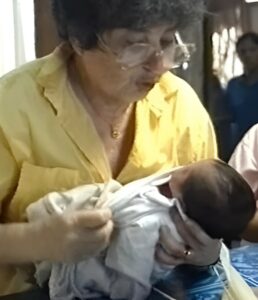
Dr Lilly Dubowitz examining a baby