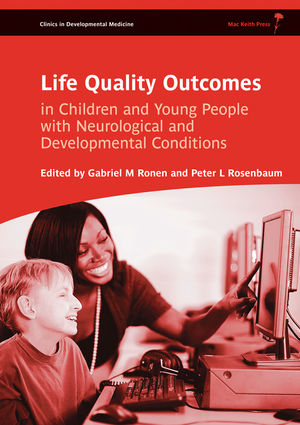
Life Quality Outcomes

Health care professionals need to understand their patients’ views of their condition and its effects on their health and well-being.

This book builds on the World Health Organization’s concepts of ‘health’, ‘functioning’ and ‘quality of life’ for young people with neurodisabilities: it emphasises the importance of engaging with patients in the identification of both treatment goals and their evaluation. Uniquely, it enables health care professionals to find critically reviewed outcomes-related information. The authors are leaders in their respective research fields and discuss theory, concepts, and evidence, and how these are applied in clinical settings and research applications.

  • Summaries of key facts enable decision making at various points of care
  • International team of experts presents up-to-date evidence-based approaches to better understand, to be able to measure and ideas to intervene to improve outcomes and decrease disability
  • Practical generic strategies to improve the care of young people with neurodevelopmental conditions
  • The non-categorical approach that the authors have taken provides opportunities for readers to find the big issues within the details
  • This book addresses relatively new and emerging concepts about the life experiences of young people growing up with neurological and developmental conditions that influence their life course.

Readership

  • Health care professionals working with children and youth with neurological and developmental conditions, wanting to expand their clinical or research horizons.
  • Frontline service providers, health services and social science researchers, clinical program managers and policy makers concerned with ensuring that their clinical or programmatic services are addressing contemporary issues as effectively as possible.
  • Students in the health professions and others in related fields (such as social work).

Clinics in Developmental Medicine

Leukodystrophies

The leukodystrophies are serious, progressive disorders of demyelination, manifesting themselves in infancy or early childhood and progressing rapidly, leading to loss of sight, hearing, speech, and ambulation, and early death.

This book is a comprehensive guide to the genetics and pathogenesis of these disorders, as well as their clinical features, diagnosis and therapy, is needed, particularly as their early identification can allow more effective treatment. Its purpose is to summarize for the reader all aspects of the inherited disorders of myelin in children and adults.

After a comprehensive overview of myelin and the role of oligodendrocytes, astrocytes and microglia in white matter disease, chapters are then devoted to individual disorders, covering their biochemical and molecular basis, genetics, pathophysiology, clinical features, diagnosis, treatment and screening. The final chapters address therapeutic approaches in leukodystrophies and present a clinical approach to diagnosing leukoencephalopathies in children and adults. The book was conceived by Hugo Moser, whose research led to major developments in the treatment of adrenoleukodystrophy, and is dedicated to him by his colleagues.

  • Edited by world leaders in research on and treatment of leukodystrophy
  • A comprehensive approach to the genetic disorders of myelin in children and adults
  • Describes individual leukodystrophies in detail, including pathogenesis, genetics, clinical features, diagnosis and treatment.

Readership

Paediatric and adult neurologists, paediatricians, geneticists.

International Review of Child Neurology Series No. 12

Language Development and Disorders

This book brings together theoretical, practical, and clinical knowledge from several disciplines that bear on language and communication in an accessible form.

Contributions from education, linguistics, psychology, pediatrics, psychiatry, neurology, neuropsychology, and speech therapy are included. They describe language development, suggest classifications for language pathology, outline the epidemiology of language difficulties, consider assessment and therapy, alternative communication systems and the impact of technology on communication aids.

The variety of perspectives that it provides will make it particularly useful to the range of specialists who are concerned with the development of communication skills and language disorders.

Clinics in Developmental Medicine No. 101-102

Inflammatory and Autoimmune Disorders of the Nervous System in Children

Inflammatory disorders of the nervous system, although individually uncommon, collectively make up 10-20% of acute paediatric neurology presentations and many are potentially treatable. Research into them is lagging behind adult research, but better diagnosis and often simple treatments could lead to substantial clinical benefit and reduction in long-term disability.

This book provides a detailed and comprehensive summary of the childhood diseases that are, or are likely to be, caused by the immune system. The authors not only describe these disorders and their treatments comprehensively, helping paediatricians and paediatric neurologists to improve their understanding and recognition of the conditions, but also highlight recent and exciting developments that will be of considerable importance in the future.

  • Clinically relevant to the practising physician
  • Experts in their fields present up-to-date diagnostic and treatment approaches
  • Recent developments in basic science clearly presented

Readership

Paediatricians and paediatric neurologists. Also researchers into autoimmune neurological diseases, adult neurologists, rheumatologists and immunologists.

Clinics in Developmental Medicine No. 184-185

Improving Quality of Life for Individuals with Cerebral Palsy through Treatment of Gait Impairment

How can the quality of life of those with cerebral palsy and associated gait impairment be improved? What needs to be done to ensure real progress in research? How can evidence for interventions be improved?

The Symposium brought together world-reknowned experts with a range of viewpoints to challenge each other and answer these questions, and prevent stagnation of outcomes. This publication unites these discussions to establish a framework to guide research efforts for the future and ensure meaningful progress. Authors consider how patient goals can be given more attention and ask how we can learn more details of the underlying neurological impairments.

  • Challenges long-held assumptions to explore the current state of research, testing, and treatment.
  • Topics are unified by common formats including bulleted key points and objectives, and specific research goals to make the results more rapidly accessible.

Readership

A useful resource for orthopaedic surgeons, physiatrists, physical therapists, kinesiologists, gait analysis experts, and other members of the interdisciplinary team involved in the identification and treatment of mobility impairments in children and young adults diagnosed with cerebral palsy.

Clinics in Developmental Medicine

Improving Hand Function in Children with Cerebral Palsy

For most children with cerebral palsy, the extent to which they can use their hands is critical to their overall development.
Over the last two decades there have been major advances in the understanding of hand function. Particularly in children with cerebral palsy, assessment of hand function has become more exact and the range of possible interventions has expanded.
Changes in treatment approaches can be seen in neurorehabilitation, orthopaedic management, developmental paediatrics and rehabilitation including occupational and physical therapy practices.
In this book, selected experts from around the world in the fields of neuroimaging, neurology, orthopaedics, anatomy, motor control and motor learning provide fundamental theoretical information for the development of hand function in children with cerebral palsy.
The book also shows how theory can be translated into practice by clinicians who provide assessment and intervention services to improve hand use in this population in sections written by researchers in occupational and physical therapy.
Linking different fields of knowledge, this book highlights new perspectives and provides the best evidence for different types of intervention. By focusing only on hand function this essential book highlights new concepts for clinicians and others working towards the overall well-being of children with cerebral palsy.
Clinics in Developmental Medicine No. 178

ICF: A Hands-on Approach for Clinicians and Families

You can freely download the ICF Code Sets for Children and Youth from the ‘Related resources’ section at the bottom of this page.

This accessible handbook introduces the World Health Organisation’s International Classification of Functioning, Disability and Health (ICF) to professionals working with children with disabilities and their families.

It contains an overview of the elements of the ICF but focusses on practical applications, including how the ICF framework can be used with children, families and carers to formulate health and management goals.

The Appendices contain case studies for individuals and interdisciplinary teams to work through and discuss, alongside other resources, and a copy of an ICF code set for children and youth is available to download online (see Further Material).

  • The first practical manual of the ICF
  • Rich in case examples
  • Great workbook for team development using the ICF as a common language

From the Introduction by Peter Rosenbaum:

‘From time to time in the field of healthcare, an exciting new development emerges to challenge and potentially transform thinking and behaviour. The International Classification of Functioning, Disability and Health (ICF) and its framework is undoubtedly one of these transformative resources and is increasingly widely used in the field of childhood disability.’

Readership

Clinicians and paediatricians in neurodisability, service providers in neurodisability, community-based health professionals, and the families of children with disabilities.

Video About the Book

Watch Peter Rosenbaum discuss the book with Bernard Dan, Editor-in-Chief of Developmental Medicine and Child Neurology:

Original Title: Die ICF-CY in der Praxis

by Olaf Kraus de Camargo and Liane Simon

Copyright 2013 by Hogrefe AG; www.hogrefe.ch

2nd Edition Copyright 2017

A Practical Guide from Mac Keith Press


Further material 

Contents

Author Appointments

Appendix 6: ICF Code Sets for Children and Youth are FREE to download as a PDF with every book purchase.

Contact [email protected] for free access if you have purchased the book from another book seller.

Hip Disorders in Childhood

There are many childhood disorders which affect the hip and its development, many of which can have lifelong sequelae.

This book brings together the authoritative opinions of a number of experienced clinicians about these disorders, discussing their aetiology, presentation, diagnosis, treatment and the range of outcomes.

There are chapters on the anatomy and embryology; physical examination; role of the hip in gait and gait analysis; and hip orthoses.

Readership

It is written for all those who manage the health of children, primarily for paediatricians, physiotherapists, occupational therapists, nurses and orthotists. Although the majority of authors are orthopaedic surgeons, it is not a book on surgery but on what every clinician should know about the developing hip joint.

Clinics in Developmental Medicine No. 160

Cranial Haemorrhage in the Term Newborn lnfant

Intracranial haemorrhage affects more than 1 liveborn term infant in 100. The range of aetiologies has been expanded from trauma due to breech or instrumental delivery, to birth asphyxia, haemorrhagic diathesis, infection and prenatal injury. A shift towards diagnosis in life has been brought about by the application of ultrasound, CT and NMR imaging. Survival of most affected infants has encouraged neonatologists and paediatric radiologists to describe their findings in the past decade, yielding a wealth of data. Medicolegal implications surrounding delivery and neonatal care have increased the demand for thorough description of perinatal intracranial events.

Clinics in Developmental Medicine No. 129

Comorbidities in Developmental Disorders

In the last decade the term ‚’comorbidity‚’ has gained popularity in the field of paediatric neurodisability, with the increasing recognition that many conditions are rarely present in isolation. Within this field, the term is often used to refer to the co-occurrence of conditions more frequently than would be expected by chance, which can include instances where one condition causes the other, where they share a common cause (for example, genetic), or where they are in fact manifestations of a single condition.

Whether it is valid to use the term ‚’comorbidity‚’ in all these situations, and how precisely it should be used, is something that the contributors to this book grapple with in their own fields of interest. The contributors, all world experts in their fields, also discuss what we can learn from the presence of comorbidities, however defined, about the aetiology and treatment of neurodevelopmental disabilities. In particular, they demonstrate how our increasing understanding of the mechanisms underlying the common association of many ‘comorbidities‚’ is helping us to understand the natural history of these conditions and improve our management of them.

  • This book examines the concept of ‘comorbidity’ in developmental disorders
  • World experts explain the mechanisms underlying the common association of many conditions
  • The contributors review the implications for treatment and management

Readership
Paediatricians, paediatric neurologists, child psychiatrists, neurodevelopmentalists, and physical, occupational and speech therapists working with children with developmental disabilities.

Clinics in Developmental Medicine No. 187