
Responding to requests for novel/unproven alternative and complementary treatments
Marilyn Wright, Sandra Gaik and Kathleen Dekker
01 Themes for discussion
02 Introduction
03 Clinical scenarios
04 Decision-making frameworks
05 Identify the issues and decision-making processes
06 Study the facts
07 Select reasonable options
08 Understand values and duties
09 Evaluate and justify options
10 Education/informed decision-making
11 Communication and collaboration
12 Sustain and review the plan
13 Clinical scenario
14 Themes for discussion
15 References
16 Themes for discussion
Sustain and review the plan
- Determine how best to document, implement, communicate and reflect on the decision and the process.
Practice guidelines were developed and are described below. Processes are summarized in an algorithm (Fig 23.1).
Overall guiding principle: Families who seek concurrent therapy are supported in their efforts if the interventions are considered to be appropriate based on practice guidelines.
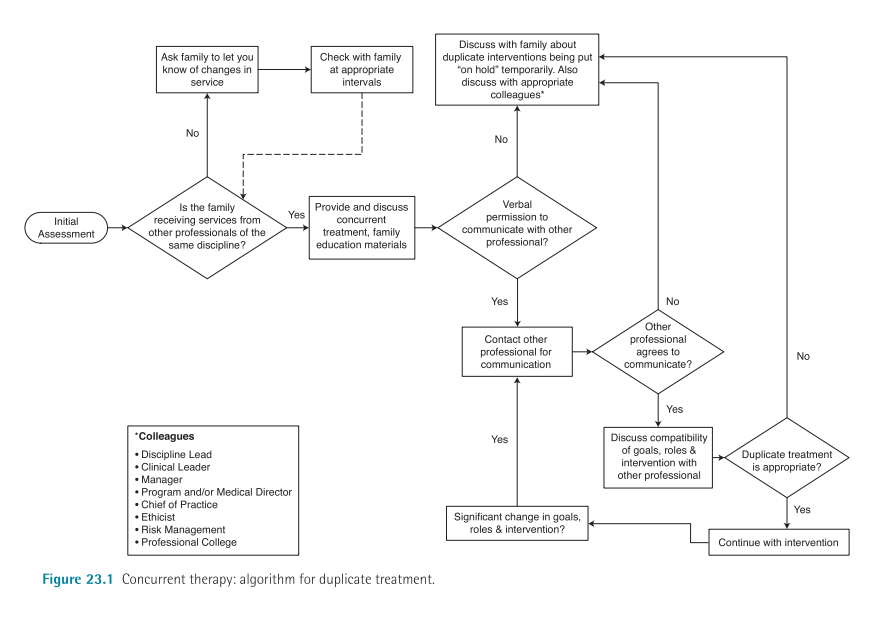
Processes are initiated by ascertaining whether families are involved with other professionals when first assessed and on an ongoing basis. If they are seeing another professional of the same discipline, they are informed of the reasons for initiating and maintaining communication between therapists and consent for ongoing communication is requested. Written educational materials are provided. This allows professionals to consult with each other and determine whether concurrent therapy is appropriate. Concurrent therapy would be considered appropriate if the treatment goals were complementary or enhance each other, if professional roles were defined and if interventions were coordinated.
Concurrent therapy would be considered questionable if the goals, roles or interventions of the concurrently treating professionals were conflicting in philosophy or approach, or were thought to pose safety risks; if there were no communication between practitioners; or if services represented an unethical or inefficient duplication of publicly funded health services.
If concurrent therapy is questionable, the situation must be discussed with the family. Consultation, as appropriate, with colleagues, administrators, ethicists, risk management specialists or professional college advisors can facilitate and inform the development of a plan. Treatment may have to be put on hold temporarily until appropriate practices are in place. All actions regarding concurrent therapy intervention must be documented according to institutional and professional association guidelines.
The guidelines were vetted by a parent representative, the institutional ethics committee and policy specialists, and incorporated into practice. Knowledge translation and exchange were promoted through the development of family education materials, presentations at conferences and incorporation into academic programs.
Concurrent therapy, practised in an ethical manner, involves regard for values and duties, communication and collaboration as described in the scenario to follow.
Review Exercise
Think of a specific example in which the decision would have to be made as to whether concurrent therapy would be questionable. We can have submission forms of text, multiple choice, quiz, specific examples the user can look at to consider the main text.