
Books
Filter by category
Filter by format
Filter by series
New releases
Bestsellers


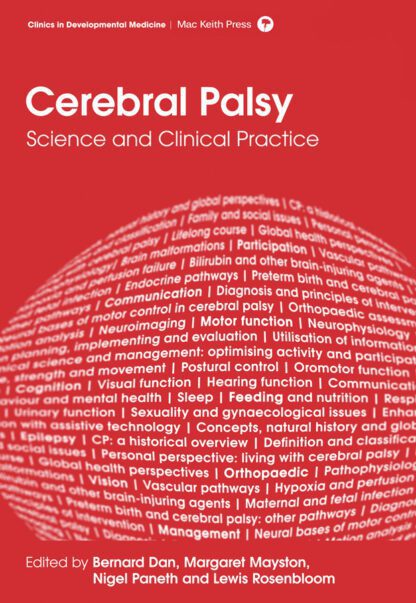
Cerebral Palsy: Science and Clinical Practice
Science and Clinical Practice
Ways to buy
Hardback edition (complete book)
£205.00
Buy individual chapters
Buy ebook edition (Amazon)
Buy ebook edition (Apple Books)
This landmark title considers all aspects of cerebral palsy from the causes to clinical problems and their implications for individuals.
An international team of experts provides clinicians and researchers with key information on the mechanisms underlying impairments in movement, development, cognition, communication, vision, feeding, behaviour, sexuality, and musculoskeletal deformities.
They present a wide range of person-centred assessment approaches, including clinical evaluation, measurement scales, neuroimaging and gait analysis. The principles of multi-disciplinary management are presented, in terms of therapist intervention, medication and surgery. The perspective of the book spans the lifelong course of cerebral palsy, taking into account worldwide differences in socio-economic and cultural factors. Many chapters are illustrated with clinical vignettes enabling direct translation into practice. Full integrated colour, with extensive cross-referencing make this a highly attractive and useful reference.
Paediatric neurologists, developmental paediatricians, rehabilitation doctors, orthopaedic surgeons, child psychiatrists, physiotherapists speech and language therapists psychologists, occupational therapists and other health and educational professionals.
Clinics in Developmental Medicine
Bernard Dan

Bernard Dan studied medicine at the Free University of Brussels (ULB) and did part of his training in paediatric neurology at Great Ormond Street Hospital in London, where he developed an interest in Angelman syndrome. He is also a rehabilitation specialist.
Bernard Dan is currently the head of the department of neurology at the University Children’s Hospital in Brussels and professor of developmental neurology, neurobiology and neurophysiology at the Free University of Brussels, medical director of the Interuniversity Reference Centre for Cerebral Palsy ULB-VUB-ULg, director of the Centre for Movement Analysis (Brugmann, ULB) and president of the Belgian Society of Paediatric Neurology.
He helped Belgian families to set up an Angelman syndrome support group, and organised the First National Symposium on Angelman Syndrome in Belgium in 1997. His research focuses on electrophysiology and motor control in movement disorders including Angelman syndrome.
Margaret Mayston

Dr Margaret Mayston is Senior Teaching Fellow in research at the Division of Biosciences, Institute of Child Health, University College London, UK.
Nigel Paneth

Nigel Paneth is Professor of Epidemiology and Biostatistics and Pediatrics in the College of Human Medicine, Michigan State University, Michigan, USA.
Lewis Rosenbloom

Lewis Rosenbloom has been a Consultant Paediatric Neurologist since 1971. He holds
an honorary appointment to the Royal Liverpool Children’s NHS Foundation Trust UK.
His special clinical, teaching and research interests are in paediatric neurodisability.
He has published widely on many aspects of cerebral palsy including feeding issues and
life expectation in disabled people.
AUTHORS’ APPOINTMENTS ix
FOREWORD xiii
PREFACE xiv
TERMINOLOGY xvi
SECTION ONE CONCEPTS, NATURAL HISTORY, AND GLOBAL PERSPECTIVES 1
1. HISTORICAL PERSPECTIVE 3
John Mantovani and David Scrutton
2. DEFINITION AND CLINICAL CLASSIFICATION 17
Peter Rosenbaum
3. PARENTING A CHILD WITH CEREBRAL PALSY: FAMILY AND SOCIAL ISSUES 27
Lucyna M Lach, Peter Rosenbaum, Sacha Bailey, Aline Bogossian, and Radha MacCulloch
4. PERSONAL PERSPECTIVES: LIVING WITH CEREBRAL PALSY 43
Jamie Beddard, Lydia Ngwana, and Karen Weinstein
5. CEREBRAL PALSY IN ADULTHOOD 49
Laura Tosi and Lewis Rosenbloom
6. A GLOBAL PERSPECTIVE 63
Maureen S Durkin
SECTION TWO PATHWAYS TO CEREBRAL PALSY 73
7. REGIONAL STRUCTURAL BRAIN MALFORMATIONS AND MOTOR IMPAIRMENT 75
Floyd H Gilles and Marvin D Nelson Jr
8. PERINATAL STROKE 91
Adam Kirton
9. PATHWAYS INVOLVING HYPOXIA–ISCHAEMIA 109
Janet M Rennie and Nicola J Robertson
10. PATHWAYS INVOLVING BILIRUBIN AND OTHER BRAIN-INJURING AGENTS 131
Dora Brites and Vinod K Bhutani
11. MATERNAL–FETAL INFECTION 151
Ruby H N Nguyen, Olaf Dammann, Pierre Gressens, and Mark R Schleiss
12. ENDOCRINE PATHWAYS 171
Edmund F La Gamma, Steven J Korzeniewski, Praveen Ballabh, and Nigel Paneth
13. NON-INFLAMMATORY AND NON-ENDOCRINE PATHWAYS FROM PRETERM BIRTH TO
CEREBRAL PALSY 185
Steven J Korzeniewski and Athina Pappas
SECTION THREE DIAGNOSIS AND PRINCIPLES OF INTERVENTION 197
14. NEURAL BASIS OF MOTOR CONTROL 199
Hans Forssberg
15. CLINICAL PRESENTATION 225
Lucinda J Carr
16. NEUROIMAGING 241
Izlem Izbudak, Andrea Poretti, Thierry A G M Huisman, and Maarten H Lequin
17. CLINICAL NEUROPHYSIOLOGY 279
Martin Smith, Lesley Notghi, and Bernard Dan
18. ORTHOPAEDIC ASSESSMENT 287
Pam Thomason, Jill Rodda, Kate Willoughby, and H Kerr Graham
19. MOTION ANALYSIS 313
Richard Baker
20. INTERVENTION PLANNING, IMPLEMENTATION, AND EVALUATION 329
Margaret Mayston
21. ENHANCING ACTIVITY AND PARTICIPATION WITH ASSISTIVE TECHNOLOGY 361
Claire Davies
22. RESOURCES FOR PEOPLE WITH CEREBRAL PALSY AND THEIR FAMILIES 371
Peter Rosenbaum and Christopher Morris
SECTION FOUR OPTIMIZING ACTIVITY AND PARTICIPATION 379
23. MUSCLE TONE, STRENGTH, AND MOVEMENT DISORDERS 381
Edward A Hurvitz, Mark Peterson, and Eileen Fowler
24. POSTURAL CONTROL 407
Mijna Hadders-Algra and Eva Brogren Carlberg
25. OROMOTOR FUNCTION 431
Cristina Mei, Angela Morgan, and Sheena Reilly
26. HAND FUNCTION 443
Ann-Christin Eliasson and Patricia Burtner
27. LOWER LIMB FUNCTION 461
Pam Thomason, Jill Rodda, Kate Willoughby, and H Kerr Graham
28. COGNITION 489
Paola Brovedani and Giovanni Cioni
29. VISUAL FUNCTION 507
Gordon N Dutton, Richard Bowman, and Elisa Fazzi
30. HEARING AND VESTIBULAR FUNCTION 529
Anne O’Hare, Ruth Henderson, and Dawn Lamerton
31. COMMUNICATION 543
Mary Jo Cooley Hidecker and Marilyn Seif Workinger
32. BEHAVIOUR AND MENTAL HEALTH 565
Gregory O’Brien† and Paul White
33. SLEEP 579
Yona Cloonan and Bernard Dan
34. EPILEPSY 587
Samantha Chan and J Helen Cross
35. FEEDING AND NUTRITION 601
Valentina Intagliata and Richard Stevenson
36. RESPIRATORY PROBLEMS 617
Rob Ross Russell
37. URINARY FUNCTION 627
Erik Van Laecke and Tryggve Nevéus
38. SEXUAL DEVELOPMENT, SEXUAL HEALTH, NEEDS, AND LIVED EXPERIENCES 637
Diana Wiegerink, Jan Willem Gorter, and Marij Roebroeck
APPENDICES 649
INDEX 677
'Cerebral Palsy: Science and Clinical Practice is a critically needed reference for interdisciplinary health professionals. It's major value is to emphasize both what is known and the challenges of using both our science and care to enhance function and participation across the life course.'
Read the full book review by Michael E Msall published in Developmental Medicine and Child Neurology.
Michael E Msall, Developmental Medicine and Child Neurology, 2015
'Overall, the volume is a comprehensive resource and can be recommended to all professionals working in the field of CP.'
Eugen Boltshauser, Neuropaediatrics, 2015
'The authors of this book are from a variety of clinical disciplines... making it an essential resource for readers across these specialist disciplines.' Annie Rangecroft, Jemma Sudlow and Olivia Smith,
ACPC Journal, 2015.
The impressive Volume, co-edited by four and with 38 distinct chapters divided between four major sections, is probably the most comprehensive available book on Cerebral Palsy (CP). It is also the first wide-ranging volume since the new definition of CP in 2007, a definition that clearly lifts CP from a mere motor disorder into something else, something broader.
The first section of the book puts CP in a human, global, conceptual, and historical perspective. It is thrilling and inspiring to read about the evolving concept of CP, starting from the early 1800’s, reaching the level of knowledge we possess today. With an understanding of history, it is easier to recognize why treatment paradigms have evolved and why they still differ globally. This section also contains personal and parental perspectives on raising a child or being a child with CP.
The last section of the book is large in content, clinically and practically oriented from a scientific viewpoint. These chapters all provide information about interventions with focus on how to optimize participation, starting from different problem areas.'
Kristina Tedroff, Acta paediatrica, 2015


