Books
Filter by category
Filter by format
Filter by series
New releases
Bestsellers


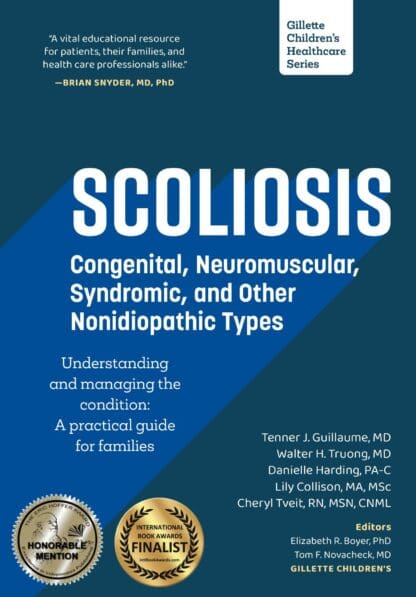
Scoliosis: Congenital, Neuromuscular, Syndromic and other Nonidiopathic Types
Understanding and managing the condition: A practical guide for families
Ways to buy
Paperback edition (complete book)
£45.00
Buy ebook edition (Amazon)
Buy ebook edition (Apple Books)
Scoliosis: Congenital, Neuromuscular, Syndromic and other Nonidiopathic Types breaks down the medical complexity of the condition into a clear, lifelong roadmap, combining world-class clinical expertise with lived experiences to empower all those involved from diagnosis to adulthood.
Whether you are an individual navigating your own care, a parent or family member supporting a loved one, or a healthcare professional looking for a broader perspective, this practical guide offers the expert-backed clarity needed to manage the condition with confidence.
It is a companion book to Idiopathic Scoliosis, which addresses scoliosis where the cause is unknown.
“A vital educational resource for patients, their families, and health care professionals alike.”
— BRIAN SNYDER, MD, PhD
“I highly recommend this impactful book for families and professionals working in the field of scoliosis.”
—ANN MARIE SUTTON, PARENT
“This book addresses a complex topic in a thorough but accessible way.”
—JOHN S. VORHIES, MD, FAAOS, FAOA
Key features:
- Clinical excellence: Delivers detailed medical insights and best-practice evidence-based treatment options.
- Holistic perspective: Explores how scoliosis impacts development, participation, and overall quality of life.
- Lifelong focus: Provides tailored guidance that evolves alongside the needs of children, adolescents, and adults.
- Empowered outcomes: Equips families with the tools and confidence to partner effectively with healthcare teams for optimal long-term health.
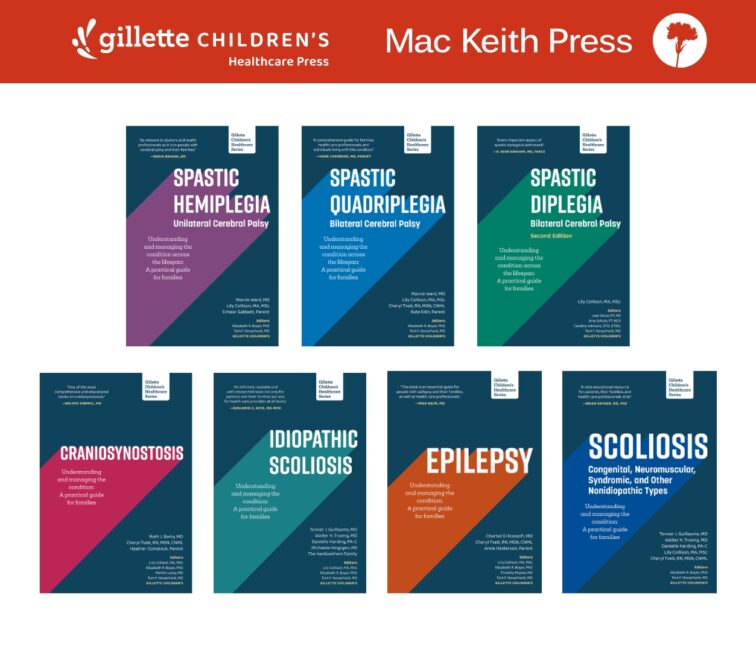
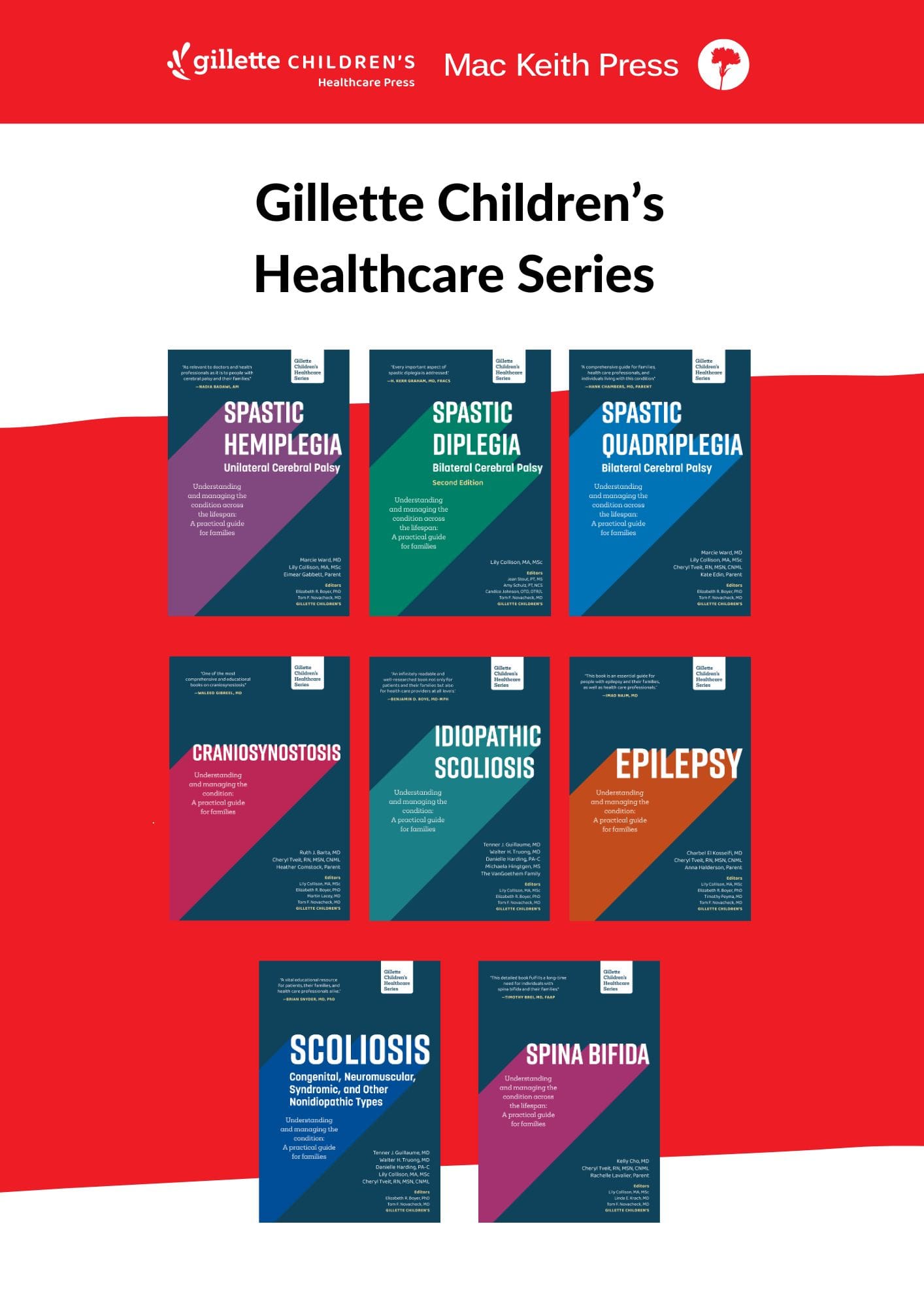
The Gillette Children’s Healthcare Series distills medical complexity into clear, actionable roadmaps for childhood-acquired physical and neurological conditions. By bridging the gap between clinical research and daily reality, this definitive collection provides a vital guide for those living with a lifelong condition.
Whether you are an individual navigating your own health journey, a parent or family member supporting a loved one, or a healthcare professional seeking a broader multidisciplinary perspective, this series provides the expert-backed clarity needed to manage the condition with confidence.
Co-published by Mac Keith Press and Gillette Children’s Healthcare Press, the series is built on a foundation of collaborative expertise. Every book combines evidence-based, best-practice treatments led by medical specialists with the invaluable lived experiences of individuals and families.
You can now purchase the complete Gillette Children’s Healthcare Series bundle at a 30% discount via this link.
Other titles in the series include:
- Craniosynostosis
- Idiopathic Scoliosis
- Spastic Hemiplegia—Unilateral Cerebral Palsy
- Spastic Quadriplegia—Bilateral Cerebral Palsy
- Spastic Diplegia—Bilateral Cerebral Palsy, second edition
- Epilepsy
- Spina Bifida
- Osteogenesis Imperfecta
Authors and editors
Foreword by Dr. Tom Novacheck
Introduction
Chapter 1 Scoliosis
1.1 Introduction
1.2 Understanding the spine
1.3 Atypical spine curvatures
1.4 Classification of scoliosis
1.5 Diagnosis of scoliosis
Key points Chapter 1
Chapter 2 Congenital scoliosis
2.1Introduction
2.2 Type of vertebral anomalies
2.3 Anomalies in other organ systems
2.4 Risk of curve progression
Key points Chapter 2
Chapter 3 Neuromuscular scoliosis
3.1 Introduction
3.2 Cerebral palsy
3.3 Spinal muscular atrophy
With Jamie Eskuri, MD
3.4 Spina bifida
3.5 Duchenne muscular dystrophy
With Jamie Eskuri, MD
3.6 Arthrogryposis multiplex congenita
With Jamie Eskuri, MD
Key points Chapter 3
Chapter 4 Syndromic scoliosis
With Tori Bahr, MD
4.1 Introduction
4.2 Rett Syndrome
4.3 Autism spectrum disorder
4.4 Neurofibromatosis
4.5 Down syndrome
4.6 Ehlers-Danlos syndrome
4.7 Prader-Willi syndrome
4.8 Other syndromes
Key points Chapter 4
Chapter 5 Other nonidiopathic scoliosis
With Teresa Schultz APRN, CNP-Pediatrics
5.1 Introduction
5.2 Syrinx
5.3 Chiari malformation type I
5.4 Tethered cord syndrome
Key points Chapter 5
Chapter 6 Overview of treatment
6.1 Why treat scoliosis?
6.2 Factors affecting treatment decisions
6.3 Overview of treatment
6.4 Evidence-based medicine and shared decision-making
Key points Chapter 6
Chapter 7 Nonsurgical treatment
7.1 Introduction
7.2 Observation
7.3 Bracing
With Kristin Smith, CO
7.4 Casting
7.5 Physical therapy
7.6 Alternative and complementary treatments
Key points Chapter 7
Chapter 8: Scoliosis surgery
8.1 Introduction
8.2 Preparing for surgery
8.3 Spinal fusion
8.4 Growth-friendly treatment
8.6 Recovery after surgery
8.6 Halo gravity traction
Key points Chapter 8
Chapter 9 Special treatment considerations
9.1 Introduction
9.2 Congenital scoliosis
9.3 Neuromuscular scoliosis
9.4 Syndromic scoliosis
9.5 Other nonidiopathic scoliosis
Key points Chapter 9
Chapter 10 Aging considerations with scoliosis
Key points Chapter 10
Chapter 11 Further reading and research
Acknowledgments
Appendices (online)
Appendix: Rib phase and rib vertebral angle difference
Glossary
References
Index
Part of the Gillette Children's Healthcare Book Series, this new title from Gillette Children's Healthcare Press and Mac Keith Press provides a lucid and comprehensive review of the etiology, pathoanatomy, and treatment of non-idiopathic types of spinal deformity. Based on evidence-based literature, it is written in a style that is accessible to patients, their families and caregivers, as well as being appropriate for healthcare professionals, researchers, educators, and students. The focus is on the four main types of non-idiopathic spine deformity. (1) Congenital – errors in vertebral development (i.e. failures of formation and/or segmentation). (2) Neuromuscular – consequence of neuromuscular conditions affecting the nervous and/or muscular systems (e.g. cerebral palsy, spinal muscular atrophy, spina bifida, Duchenne muscular dystrophy, arthrogryposis multiplex congenita). (3) Syndromic – induced by a genetic syndrome (e.g. Rett syndrome, autism spectrum disorder, neurofibromatosis, Down syndrome, Ehlers-Danlos syndrome, Prader-Willi syndrome). (4) Other non-idiopathic – provoked by spinal cord malformations – syrinx, Chiari malformation type I, or tethered cord syndrome.
The authors introduce the three-dimensional nature of spine pathoanatomy, where the deformity occurs in all three anatomic planes involving different functional and structural regions of the spine (cervical, thoracic, lumbar, and sacrum/pelvis). Scoliosis is the projection of the deformity onto the coronal plane, kyphosis/lordosis is the projection of the deformity onto the sagittal plane, and torsion/rotation is the projection of the deformity onto the axial plane. Spine development is examined from in utero to skeletal maturity, highlighting how the pubertal growth spurt accelerates deformity progression in adolescence, and also considers issues of adults with distorted spines during aging. The authors explain how spine deformity is classified according to the cause (congenital, neuromuscular, syndromic, or non-idiopathic spinal cord malformations) and age at onset (early – infantile or juvenile and later – adolescent).
Common signs and symptoms of spine pathoanatomy that parents and care providers should notice are outlined and the importance of timely referral to a spine specialist is emphasized. Creating an effective treatment plan is predicated on a comprehensive medical history, physical exam, and imaging studies that includes multi-planar spine radiographs with or without magnetic resonance imaging to visualize all relevant musculoskeletal pathology. For each category of spine deformity, the book is structured to guide readers through the various treatment modalities, the selection based on the underlying diagnosis, patient age, anatomic location, severity of deformity, and coexisting medical comorbidities.
Chapters 6 through 9 are dedicated to an overview of therapies, covering both nonsurgical options (observation, bracing, casting, physical therapy, alternative treatments) and surgical interventions (spinal fusion, growth-friendly spine instrumentation, halo gravity traction). Chapter 9 delves into specific considerations relevant to congenital, neuromuscular, syndromic, or non-idiopathic cord abnormalities. A unique aspect of this book is the inclusion of the lived experiences of children with scoliosis and their families. Complementing the didactic medical information, personal stories are interspersed throughout the text, offering a human dimension to this disorder.
Scoliosis: Congenital, Neuromuscular, Syndromic, and Other Nonidiopathic Types serves as a vital educational resource for patients, their families, and healthcare professionals alike, emphasizing evidence-based best practices and providing guidance for exploring the literature and further research. Beyond the pragmatic medical information provided, the text underscores the critical partnerships among patients, their families/caretakers, and healthcare professionals in optimizing outcomes for individuals living with this lifelong condition.
Brian Snyder for DMCN: https://onlinelibrary.wiley.com/doi/10.1111/dmcn.70054