Books
Filter by category
Filter by format
Filter by series
New releases
Bestsellers


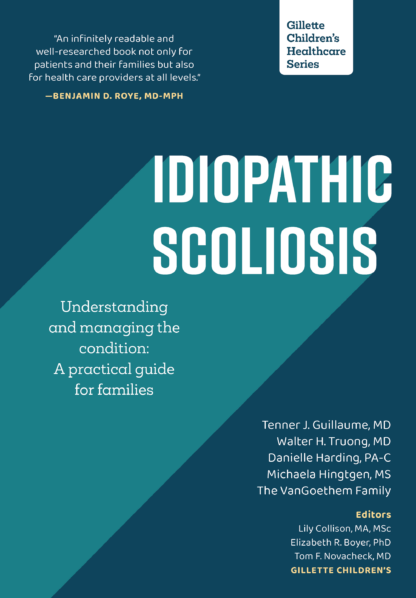
Idiopathic Scoliosis
Understanding and managing the condition: A practical guide for families
Ways to buy
Paperback edition (complete book)
£45.00
Buy ebook edition (Amazon)
Buy ebook edition (Apple Books)
Idiopathic Scoliosis breaks down the medical complexity of the condition into a clear, lifelong roadmap, combining world-class clinical expertise with lived experiences to empower all those involved from diagnosis to adulthood.
Whether you are an individual navigating your own care, a parent or family member supporting a loved one, or a healthcare professional looking for a broader perspective, this practical guide offers the expert-backed clarity needed to manage the condition with confidence.
It is a companion book to Scoliosis: Congenital, Neuromuscular, Syndromic and other Nonidiopathic Types, which addresses scoliosis where the cause is known.
“An infinitely readable and well-researched book not only for patients and their families but also for health care providers at all levels.”
—BENJAMIN D. ROYE, MD-MPH
“Our daughter was diagnosed with juvenile idiopathic scoliosis right before she started kindergarten, and we were so worried. We wish we had this book during that time as it answers so many questions.”
—AMBER MARLATT, PARENT
“As up-to-date and inclusive as a textbook written for medical professionals while being as easily readable as a novel for children with scoliosis and their families. An indispensable source of comfort for all scoliosis patients.”
—MUHARREM YAZICI, MD
Key features:
- Clinical excellence: Delivers detailed medical insights and best-practice evidence-based treatment options.
- Holistic perspective: Explores how idiopathic scoliosis impacts development, participation, and overall quality of life.
- Lifelong focus: Provides tailored guidance that evolves alongside the needs of children, adolescents, and adults.
- Empowered outcomes: Equips families with the tools and confidence to partner effectively with healthcare teams for optimal long-term health.
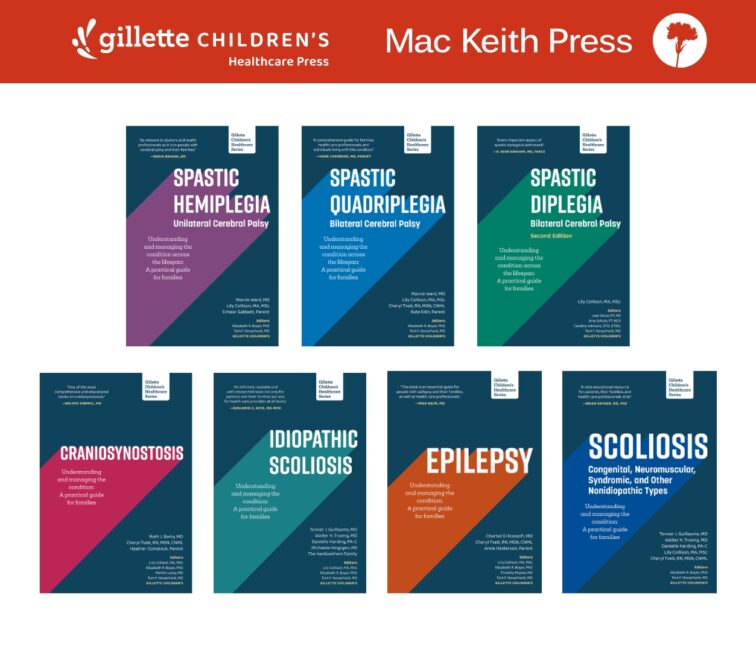
The Gillette Children’s Healthcare Series distills medical complexity into clear, actionable roadmaps for childhood-acquired physical and neurological conditions. By bridging the gap between clinical research and daily reality, this definitive collection provides a vital guide for those living with a lifelong condition.
Whether you are an individual navigating your own health journey, a parent or family member supporting a loved one, or a healthcare professional seeking a broader multidisciplinary perspective, this series provides the expert-backed clarity needed to manage the condition with confidence.
Co-published by Mac Keith Press and Gillette Children’s Healthcare Press, the series is built on a foundation of collaborative expertise. Every book combines evidence-based, best-practice treatments led by medical specialists with the invaluable lived experiences of individuals and families.
You can now purchase the complete Gillette Children’s Healthcare Series bundle at a 30% discount via this link.
Other titles in the series include:
- Craniosynostosis
- Spastic Hemiplegia–Unilateral Cerebral Palsy
- Spastic Quadriplegia–Bilateral Cerebral Palsy
- Spastic Diplegia–Bilateral Cerebral Palsy, second edition
- Epilepsy
- Spina Bifida
- Osteogenesis Imperfecta
- Scoliosis: Congenital, Neuromuscular, Syndromic, and Other Causes
Authors and Editors
Series Foreword
Series Introduction
- Scoliosis
1.1. Introduction
1.2. Understanding the spine
1.3. Atypical spine curvatures
1.4. Classification of scoliosis
1.5. Diagnosis of scoliosis
Key points Chapter 1
- Idiopathic scoliosis
2.1. Introduction
2.2. Classification and related Information
2.3. Idiopathic scoliosis: Age of diagnosis
2.4. Overview of treatment
Key points Chapter 2
- Nonsurgical treatment
3.1. Introduction
3.2. Observation
3.3. Bracing
With Kristin Smith
3.4. Casting
3.5. Physical therapy
With Michelle Engberg
3.6. Alternative and complementary treatments
Key points Chapter 3
4 Scoliosis surgery
4.1. Introduction
4.2. Preparing for surgery
4.3. Spinal fusion
4.4. Growth-friendly treatment
4.5. Vertebral body tethering
4.6. Recovery after surgery
4.7. Halo gravity traction
Key points Chapter 4
- The adult with idiopathic scoliosis
5.1. Introduction
5.2. Transition to adult care
With Tori Bahr
5.3. Adulthood with idiopathic scoliosis
With Joseph Perra
Key points Chapter 5
- Living with idiopathic scoliosis
- Further reading and research
With Elizabeth R. Boyer
Acknowledgments
Appendices (online only)
Appendix 1. Kyphosis and lordosis
Appendix 2. “Other” scoliosis
Glossary
References
Index
This book is about scoliosis. It written on a level for patients, families, and physicians not familiar with scoliosis.
The book's purpose is to provide simply explained information on scoliosis types, etiology, and treatment in a way that relates to patients and families.
It does this well.
The book targets patients, parents, and physicians with minimal knowledge about scoliosis.
This book covers idiopathic scoliosis and delineates it from other types of scoliosis. The clarity is excellent. It is well organized into seven chapters.
The first chapter introduces the subject and discusses atypical spinal curvatures, and the classification and diagnosis of scoliosis. The second chapter discusses idiopathic scoliosis, including its classification and an overview of treatment. The following two chapters discuss nonsurgical and surgical treatment, beginning with observation, bracing, casting, physical therapy, and other complementary treatments. The chapter on surgical treatment includes spinal fusion, growth-friendly treatment, vertebral body tethering, and halo gravity traction. The subsequent chapters cover adults with idiopathic scoliosis and further readings and resources. The book does a great job of intertwining real patient experiences. There are minimal and simple illustrations, but these are adequate.
This is a high-quality book written by excellent and respected authors. It does a comprehensive job of explaining scoliosis at an easily understandable level.
I would highly recommend this book for an appropriate audience.
Lawrence Haber, MD(Ochsner Hospital for Children)
Idiopathic Scoliosis: Understanding and managing the condition: A practical guide for families represents a valuable contribution to the literature. Written by a medical team from Gillette Children's Hospital and Clinics also involving the family of one scoliosis patient, it offers a comprehensive overview of the condition, spanning from basic anatomy and classification to treatment options and the lived experience of patients and their families.
One of the book's notable strengths is its accessibility. The language is clear and concise, carefully avoiding overly technical terminology which makes it well-suited for a diverse audience, including patients, families, and non-specialist healthcare providers. The authors effectively employ visual aids; the illustrations and diagrams are clear, informative, and contribute significantly to the reader's understanding of complex concepts such as spinal biomechanics and the three-dimensional nature of the deformity.
The inclusion of patient narratives, such as Lila's account, is another commendable feature. These personal stories offer invaluable insights into the lived experiences of individuals with scoliosis, highlighting the emotional, social, and physical challenges they face, and fostering a more holistic understanding of the condition.
The book adequately addresses surgical management, though there could be a more comprehensive and nuanced discussion of conservative treatment strategies. Spinal orthotics and exercise-based therapies, for instance, play a crucial role in the management of scoliosis, and their potential to influence curve progression and improve functional outcomes deserves greater emphasis, while stressing the importance of a multidisciplinary approach in scoliosis care. The coordinated efforts of physicians, orthotists, physical therapists, and other healthcare professionals are essential for optimizing treatment outcomes and addressing the diverse needs of patients. This must also include patient education, shared decision-making, and strategies to enhance patient compliance.
Overall, Idiopathic Scoliosis: Understanding and managing the condition: A practical guide for families is a valuable resource characterized by clear explanations, helpful visuals, and inclusion of personal narratives. To further enhance its clinical utility, readers must have in mind the importance of a multidisciplinary approach, which also considers conservative treatment options when indicated.
Stefano Negrini and Carmelo Pulici in DMCN: https://onlinelibrary.wiley.com/doi/10.1111/dmcn.16349
Related Books


Improving Quality of Life for Individuals with Cerebral Palsy through Treatment of Gait Impairment
Available as:
Ebook, Paperback