Books
Filter by category
Filter by format
Filter by series
New releases

Bestsellers


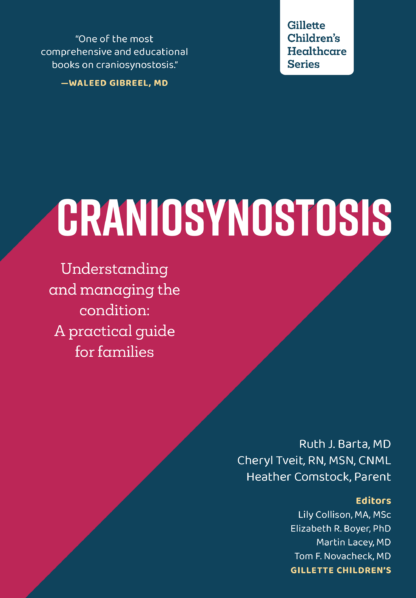
Craniosynostosis
Understanding and managing the condition: A practical guide for families
Ways to buy
Paperback edition (complete book)
£45.00
Buy ebook edition (Amazon)
Buy ebook edition (Apple Books)
Craniosynostosis breaks down the medical complexity of the condition into a clear, lifelong roadmap, combining world-class clinical expertise with lived experiences to empower all those involved from diagnosis to adulthood.
Whether you are an individual navigating your own care, a parent or family member supporting a loved one, or a healthcare professional looking for a broader perspective, this practical guide offers the expert-backed clarity needed to manage spina bifida with confidence.
“One of the most comprehensive and educational books on craniosynostosis.”
—WALEED GIBREEL, MD
“The book I wish I had when my son was diagnosed with sagittal craniosynostosis.”
—ELAINE L. KINSELLA, PARENT
“A remarkably comprehensive review of all things related to craniosynostosis.”
—CHRISTOPHER R. FORREST, MD
Key features:
- Clinical excellence: Delivers detailed medical insights and best-practice evidence-based treatment options.
- Holistic perspective: Explores how spina bifida impacts development, participation, and overall quality of life.
- Lifelong focus: Provides tailored guidance that evolves alongside the needs of children, adolescents, and adults.
- Empowered outcomes: Equips families with the tools and confidence to partner effectively with healthcare teams for optimal long-term health.
The Gillette Children’s Healthcare Series distills medical complexity into clear, actionable roadmaps for childhood-acquired physical and neurological conditions. By bridging the gap between clinical research and daily reality, this definitive collection provides a vital guide for those living with a lifelong condition.
Whether you are an individual navigating your own health journey, a parent or family member supporting a loved one, or a healthcare professional seeking a broader multidisciplinary perspective, this series provides the expert-backed clarity needed to manage the condition with confidence.
Co-published by Mac Keith Press and Gillette Children’s Healthcare Press, the series is built on a foundation of collaborative expertise. Every book combines evidence-based, best-practice treatments led by medical specialists with the invaluable lived experiences of individuals and families.
You can now purchase the complete Gillette Children’s Healthcare Series bundle at a 30% discount via this link.
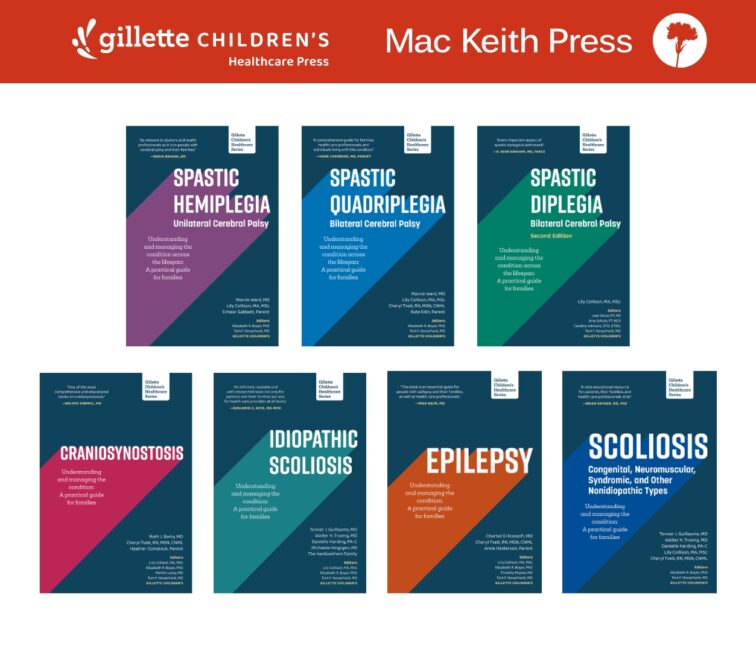
Other titles in the series include:
- Idiopathic Scoliosis
- Spastic Hemiplegia–Unilateral Cerebral Palsy
- Spastic Quadriplegia–Bilateral Cerebral Palsy
- Spastic Diplegia–Bilateral Cerebral Palsy, second edition
- Epilepsy
- Spina Bifida
- Osteogenesis Imperfecta
- Scoliosis: Congenital, Neuromuscular, Syndromic, and Other Causes
Watch the authors discuss Craniosynostosis with the Children’s Craniofacial Association
Author and Editors
Series Foreword
Series Introduction
- Craniosynostosis
- Introduction
- Typical brain and skull development
- Classifications of craniosynostosis
- Prevalence, causes and risk factors, and symptoms
- Diagnosis
- Why treatment is important
- Best practice
Key points Chapter 1
- Nonsyndromic craniosynostosis
- Introduction
- Sagittal CS
- Metopic CS
- Coronal CS
- Lambdoid CS
- Cognition, behavior, speech, and language
Key points Chapter 2
- Syndromic craniosynostosis
- Introduction
- CS syndromes
- Prevalence and genetics
- Head characteristics
- Additional characteristics
- Airway, feeding and eye closure
- Cognition, behavior, speech, and language
Key points Chapter 3
- Surgical management and treatment in infancy
4.1 Introduction
4.2 Preparing for surgery
4.3 Surgical repair
4.4 Recovering from surgery
Key points Chapter 4
- Deformational plagiocephaly
- Introduction
- Causes and risk factors
- Treatment
Key points Chapter 5
- Growing up with nonsyndromic craniosynostosis
- Introduction
- Additional surgery
Key points Chapter 6
- Growing up with syndromic craniosynostosis
- Introduction
- Additional surgery
Key points Chapter 7
- Living with craniosynostosis
- Further Reading and involvement in research
Acknowledgments
Glossary
References
Index
This is a very nice publication focusing on helping families understand the diagnosis and management of craniosynostosis. It gives appropriate information to families that does not overwhelm yet is comprehensive. There are multiple patient and family accounts throughout the book, which families will find helpful.
The book's purpose is to condense the extremely complicated topic of craniosynostosis down to manageable information for parents and family members of children with craniosynostosis. The book does not include a direct preface; however, there is a series forward and a series introduction that identify a purpose. The book fills a void in published literature by acting as a guide for families of children with craniosynostosis, and it meets the objectives nicely.
The book's primary audience is families of children with craniosynostosis. The book seamlessly presents guidance to parents for office visits, possible interventions, and what to expect long term. This will also be an ideal book for nonsurgical medical professionals in pediatrics. It is in-depth enough for pediatricians or neonatologists to be conversant with a patient's family yet will not overwhelm with surgical details. The book certainly meets the needs of the intended audience. The author has substantial training and experience in craniosynostosis.
The book is divided into logical chapters and sections and flows well. The book covers the elements of care that are important to know for a family concerned about their child's head shape. It flows naturally from the newborn period, to what would be expected on physical exam, adjunct imaging studies that might be required, timing of interventions, and what to expect in the near, mid, and long term. The illustrations and photos do not inundate with too much information and are on-topic and pertinent. The writing is for parents, not intimidating, and takes complex conditions and presents the details in a manner that is easy to understand. The references and index are appropriate in length and topic. The book would benefit from a sentence or two on the physical exam to delineate scaphocephaly from dolichocephaly as it is a common referral seen in the office. This would help families understand the difference where a loss of posterior height is seen in the scaphocephalic patient but not in dolichocephaly. The key to diagnosis is the physical exam.
This is a very nice book for families with children who have an abnormal head shape and are concerned about craniosynostosis. The book covers the topics for the targeted audience quite well. There is a section of the book dedicated to deformational and positional plagiocephaly that might be missed by parents given the title of the book. In future editions it may be beneficial to add to the title to encompass this condition as well. This book is very easy to read, incredibly informative, and beneficial for families who have children with craniosynostosis and plagiocephaly.
Michael T. Friel, MD (Ochsner Hospital for Children)