Books
Filter by category
Filter by format
Filter by series
New releases
Bestsellers


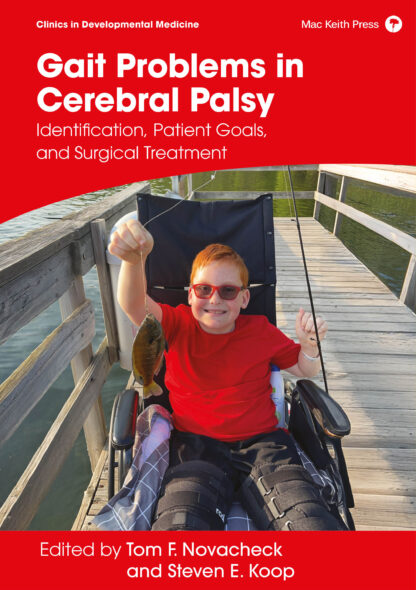
Gait Problems in Cerebral Palsy: Identification, Patient Goals, and Surgical Treatment
Ways to buy
Hardback with 2-year video access edition (complete book)
£150.00
Buy ebook edition (Amazon)
Buy ebook edition (Apple Books)
Related e-learning: Gait Problems in Cerebral Palsy: Identification, Patient Goals, and Surgical Treatment (integrated online resource)
£30.00 every 2 years and a £120.00 sign-up fee
Gait Problems in Cerebral Palsy focuses on the surgical care and postoperative rehabilitation of children with cerebral palsy as they grow through early and late childhood, and adolescence.
This product is available in different formats:
- Hardback with 2-year video access included (navigate to ‘Memberships’ via your ‘My Account’ page after completing your purchase). To continue accessing the supporting video after the initial 2-year membership, you will need to purchase a new subscription.
- Ebook with 2-year video access included (navigate to ‘Memberships’ via your ‘My Account’ page after completing your purchase). To continue accessing the supporting video after the initial 2-year membership, you will need to purchase a new subscription.
- Integrated online resource with 2-year renewable access (full integration of text with videos via our online platform.
Please visit the ‘Gait Problems in Cerebral Palsy FAQs’ page if you need help with choosing which format is best for you or if have any queries on how to access each format.
The book describes the neurologic and musculoskeletal issues that are frequently treated in children in each age group. It describes how to evaluate the children, create problem lists, make treatment choices, carry out interventions, and provide rehabilitation therapies. It:
- Emphasizes the critical importance of dialogue with children and parents, and age-related data derived from the GOAL questionnaire is provided to focus insight on the priorities of patients and families.
- Presents descriptions of patient and family priorities, decision-making and surgical techniques, and rehabilitation therapies for each age group.
- Includes individual chapter commentaries written by experts.
- Offers consistent chapter structures that emphasize clarity and brevity, supplemented by figures and tables.
- Highlights the importance of building collaborative multidisciplinary clinical teams.
- Includes access to 112 videos which demonstrate clinical teams at work with patients, surgical techniques, and rehabilitation activities. If you have purchased the book elsewhere, please contact [email protected] or head over to this page to sign up to the video membership.
Essential reading for orthopaedic surgeons, physiatrists, physical therapists, kinesiologists, gait analysis experts, and other members of the interdisciplinary team involved.
This new title is the evolution of the highly influential Identification and Treatment of Gait Problems in Cerebral Palsy, 2nd Edition, edited by James Gage, Michael Schwartz, Steven Koop, and Tom Novacheck, published by Mac Keith Press in 2009.
Author Video
Editor: Tom F Novacheck, M.D

Tom F Novacheck, M.D., Pediatric Orthopedic Surgeon, Chair of the Cerebral Palsy Institute, Gillette Children’s, and Professor, University of Minnesota Department of Orthopedic Surgery.
Dr Novacheck is a Pediatric Orthopedic Surgeon at Gillette Children’s (St. Paul, Minnesota) since 1991 following his fellowship training in Paediatric Orthopaedics at Newington Children’s Hospital (Connecticut). He has been a member of the Gillette/Connecticut Children’s/KU Leuven Gait Analysis Course Faculty since 1992 and course director when hosted in MN. At Gillette, he is Chair of the Cerebral Palsy Institute and is a professor of Orthopaedic Surgery at the University of Minnesota (Minneapolis, Minnesota). His practice currently is focused on caring for individuals with cerebral palsy and hip dysplasia. He is past president of the American Academy of Cerebral Palsy and Developmental Medicine Gait (AACPDM) in 2021-2022, past president of the Gait and Clinical Movement Analysis Society (GCMAS) in 2001, and past Editor-in-Chief of Gait & Posture (1999-2002). His research interests include the analysis of normal and pathological walking, refinement and development of gait analysis techniques, and short and long-term outcomes assessment of treatment for cerebral palsy gait dysfunction and he has published more than 70 peer reviewed articles and 25 book chapters.
Editor: Steven E. Koop, M.D

Steven E. Koop, M.D., Pediatric Orthopedic Surgeon and Professor, University of Minnesota Medical School.
Dr Koop’s worked at Gillette Children’s for his entire career and focused on the care of children with neuromuscular conditions where he had the opportunity to follow children into adulthood. This continuity provided perspective on what it means to grow up with a neuromuscular condition, and it helped him learn what was important and helpful to his patients and their families. Through leadership roles at Gillette, he participated in the work of building collaborative multidisciplinary care teams.
Contents
Author Appointments ix
Commentary Author Appointments xi
Foreword xiii
Introduction xvii
Videos xix
SECTION A: Age 4–7 years
1 Patient and Family Priorities: Principles, Tools, and Gait Outcomes Assessment List (GOAL) Results in Children 4 to 7 years old at Gillette Children’s 3
Elizabeth R. Boyer, Jean L. Stout, Katie Walt, and Steven E. Koop
2 Multidisciplinary Evaluation and Selective Dorsal Rhizotomy for Permanent Tone Management 24
Marcie Ward, Jennifer Laine, and Peter Kim
3 Rehabilitation after Selective Dorsal Rhizotomy 40
Michelle Engberg, Heather Forst, Jackie Norling, Therese O’Bright, Jackie Price, Amy Schulz, and Katie Wilkins
SECTION B: Age 8–12 years
4 Patient and Family Priorities and Gait Outcomes Assessment List (GOAL) Results in Children 8 to 12 years old at Gillette Children’s 51
Jean L. Stout, Elizabeth R. Boyer, Katie Walt, and Steven E. Koop
5 Femoral Anteversion 66
Andrew G. Georgiadis
6 Tibiofibular Torsion 92
Andrew G. Georgiadisvi
7 Foot Deformity 115
Stephen Sundberg and Sue Sohrweide
8 Iliopsoas 142
Trenton Cooper and Jennifer Nelson
9 Adductor 150
Kyle Miller and Jennifer Nelson
10 Hamstrings 158
Deven Carroll, Michael T. Healy, and Daniel J. Miller
11 Rectus Femoris 174
Nickolas Nahm and Michael T. Healy
12 Gastrocsoleus 183
Emmalynn J. Sigrist and Rocio H. Riveros-Charry
13 Rehabilitation after Juvenile Single-Event Multilevel Surgery Procedures 197
Michelle Engberg, Heather Forst, Jackie Norling, Therese O’Bright, Jackie Price, Amy Schulz, and Katie Wilkins
SECTION C: Age 13–17 years
14 Patient and Family Priorities and Gait Outcomes Assessment List (GOAL) Results in Adolescents 13 to 17 years old at Gillette Children’s 219
Jean L. Stout, Elizabeth R. Boyer, Katie Walt, and Steven E. Koop
15 Crouch Management with Anterior Distal Femoral Hemiepiphyseodesis, Distal Femoral Extension Osteotomy, Patellar Tendon Advancement, or Tibial Tubercle Advancement 231
Tom F. Novacheck and Jean L. Stout
16 Adolescent Foot and Arthrodesis Procedures 257
Steven E. Koop and Sue Sohrweide
17 Hip Dysplasia 267
Alison J. Dittmer and Andrew G. Georgiadis
18 Rehabilitation after Orthopedic Surgery in Adolescents 293
Michelle Engberg, Heather Forst, Jackie Norling, Amy Schulz, Therese O’Bright, Jackie Price, and Katie Wilkins
Afterword 312
Tom F. Novacheck and Steven E. Koop
Contents vii
Appendices
1 Complete Item and Domain Names Derived from the Gait Outcomes Assessment List (GOAL) Questionnaire 314
2 Anticipated Function at Discharge 317
3 Physical Therapy Goals and Activities for Inpatient Rehabilitation Stay Following Selective Dorsal Rhizotomy 320
4 Occupational Therapy Goals and Activities for Inpatient Rehabilitation Stay Following Selective Dorsal Rhizotomy 327
5 Outpatient Physical Therapy Progression Months 1–12 331
6 Before Your Child’s Single-Event Multilevel Surgery 335
7 What to Expect from Your Inpatient Rehabilitation Stay Following Single-Event Multilevel Surgery 337
8 Surgical Procedure: Adductor Lengthening 339
9 Surgical Procedure 341
10 Surgical Procedure: Pelvic Osteotomy (With or Without) Proximal Femoral Derotation Osteotomy – Neuromuscular Diagnoses 344
11 Surgical Procedure: Proximal Femoral Derotational Osteotomy 347
12 Surgical Procedure: Psoas Lengthening 350
13 Surgical Procedure: Tibial Derotation Osteotomy and Gastrocnemius/Soleus Procedures 353
14 Surgical Procedure: Distal Femoral Extension Osteotomy (With Patellar Tendon Advancement) 356
15 Surgical Procedure: Ganz Periacetabular Osteotomy 359
16 Surgical Procedure: Rectus Femoris Transfer 363
17 Tibial Tubercle/Patellar Tendon Advancement 366
Index 369
Contents
'This chapter presents comprehensively the assessment and management of tibiofibular (TF) torsion. The chapter provides clarity in a subject often complicated in the literature by poor definitions, large error in measurements, and poor understanding of the indications and outcomes.' Timothy Theologis from commentary to Chapter 6 'Tibiofibular Torsion'.
'This chapter nicely identifies how to examine the adductor musculature and separate Gracilis from adductor contractures. It also outlines the authors’ philosophy on how to determine and limit the extent of the surgical procedure'.
James McCarthy from the commentary to Chapter 8 'Adductor'.
'How appropriate that the first chapter in this excellent and authoritative book should address the concept of ‘patient goals’.
Erich Rutz, from commentary to Chapter 1 'Patient and Family Priorities: Principles, Tools, and Gait Outcomes Assessment List (GOAL) Results in Children 4 to 7 years old at Gillette Children’s.'
The following quotes are taken from the chapter commentaries featured in the book:
This book serves as a rapid review for guiding orthopedic practitioners through the process of pediatric patient evaluation. It focuses on treatment variation by patient age, severity of impairment, and goals of care. It provides a series of concise, bulleted sections for each phase of rehabilitative care.
The book's purpose is to update and consolidate resources, both textbooks and patient-oriented materials, on the interventional management of lower limb functional impairment related to cerebral palsy (CP). It explicitly avoids a discussion of non-operative management and indeed advises readers to be familiar with prior texts, such as The Identification and Treatment of Gait Problems in Cerebral Palsy, 2nd Edition, Gage et al. (Wiley, 2009). As a result, the book seemingly attempts to be a pocket manual to help guide common, CP-related orthopedic procedures while briefly dipping into the holistic evaluation of children with CP. This strategy somewhat detracts from a clear purpose as either a "quick reference" or a comprehensive text. Therefore, the book meets its objectives to a high degree but in a way that does not quite maximize its worthiness.
The book targets clinicians who share a role in the treatment of lower limb abnormalities as they occur in children with cerebral palsy. It appears most targeted to pediatric orthopedic surgeons and physical therapists. The materials presented could also benefit complex pediatric care physicians, occupational therapists, physiatrists, neurosurgeons, plastic surgeons, and gait lab technicians. The book provides quality instruction and education to the intended audience. The book distills years of practice expertise from leaders in pediatric orthopedic surgery as it relates to cerebral palsy, and the authors are highly credible authorities based on their recognized expertise, credentials, and publications.
This book serves as a guide to established practices in treating children with cerebral palsy, a specialized field requiring dedicated training. It comprises three sections organized by ages grouped 4-7, 8-12, and 13-17 years. Arranging chapters by age group is practical as there are significant intergroup differences in orthopedic interventions. Sections are separated into segments including goal assessment, clinical information, and surgical interventions.
The information presented is clear and unpretentious, and the bulleted text is easy to follow. The book shines in many areas. Gait evaluation and kinematic data is an uncommon resource. Using functional goals as a cornerstone of care is a true strength, as the complex nature of CP necessitates advanced planning with many different disciplines. The book's visual features are strong and follow a logical sequence: physical examination, then radiographic evaluation, artistic depictions of planes of movement, advanced evaluation, and finally surgical procedures. Shortcomings are few, though there are occasional entries that are not explained until later in the chapter. For instance, a mention of Reimer's migration percentage on one page comes without explanation or reference to the figure explaining it on a subsequent page. One appendix is simply titled "Surgical Procedure" whereas all other appendices are more descriptive. The book states its intention to focus on surgical intervention only but dives into comprehensive clinical evaluation, including history taking, physical examination, as well as postoperative rehabilitation. Some readers may be keen to read about closely related treatments such as bracing, casting, selective neurectomy, and chemodenervation. Including or mentioning these practices would add value to the book without causing it to become bloated.
This is a well-written book that is useful as a brief review of the surgical management of children with cerebral palsy. Some of the leaders in the field have contributed to this book, making it a worthwhile endeavor. It is not a subsequent edition and instead distills multiple previous texts including The Identification and Treatment of Gait Problems in Cerebral Palsy, 2nd Edition, Gage et al. (Wiley, 2009) and educational material used at Gillette Children's. The nature of CP makes a quick guide difficult to produce. Thus, while the information presented here can be accessed quickly and is easy to process, it is not comprehensive. A significantly broader book seeking to encompass all types of treatments and principles indicated in those with CP is Cerebral Palsy: From Childhood to Adulthood, 4th Edition, authored by Christos Panteliadis (Springer, 2025). Nonetheless, I recommend the reviewed book to orthopedic surgeons, physical therapists, and physiatrists looking for a brief introduction or review of the methods of common surgical corrections associated with sequelae of cerebral palsy.
Matthew Amodeo, MD(Ochsner Health), for Doody's Publishers' Club
Related Courses
Related Books


Identification and Treatment of Gait Problems in Cerebral Palsy, 2nd Edition
Available as:
Ebook, Hardback