Books
Filter by category
Filter by format
Filter by series
New releases
Bestsellers


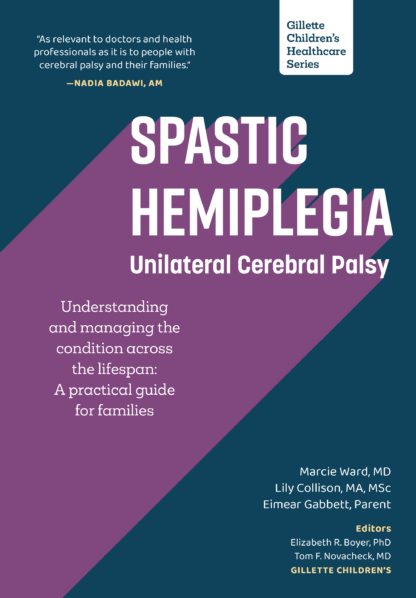
Spastic Hemiplegia–Unilateral Cerebral Palsy
Understanding and managing the condition across the lifespan: A practical guide for families
Ways to buy
Paperback edition (complete book)
£45.00
Buy ebook edition (Amazon)
Buy ebook edition (Apple Books)
Spastic Hemiplegia breaks down the medical complexity of the condition into a clear, lifelong roadmap, combining world-class clinical expertise with lived experiences to empower all those involved from diagnosis to adulthood.
Whether you are an individual navigating your own care, a parent or family member supporting a loved one, or a healthcare professional looking for a broader perspective, this practical guide offers the expert-backed clarity needed to manage the condition with confidence.
“As relevant to doctors and health professionals as it is to people with cerebral palsy and their families.”
—NADIA BADAWI, AM
“This book gets my highest recommendation.”
—NATHALIE MAITRE, MD, PhD, PARENT
“Wow! This book is the most amazing and comprehensive source of information available for persons with unilateral CP and their families I have ever seen, and it should be required reading for any professionals who care for them.”
—DIANE DAMIANO, PhD, FAPTA
“A must-read for all.”
—BENJAMIN SHORE, MD, MPH, FRCSC
Key features:
- Clinical excellence: Delivers detailed medical insights and best-practice evidence-based treatment options.
- Holistic perspective: Explores how spastic hemiplegia impacts development, participation, and overall quality of life.
- Lifelong focus: Provides tailored guidance that evolves alongside the needs of children, adolescents, and adults.
- Empowered outcomes: Equips families with the tools and confidence to partner effectively with healthcare teams for optimal long-term health.
The Gillette Children’s Healthcare Series distills medical complexity into clear, actionable roadmaps for childhood-acquired physical and neurological conditions. By bridging the gap between clinical research and daily reality, this definitive collection provides a vital guide for those living with a lifelong condition.
Whether you are an individual navigating your own health journey, a parent or family member supporting a loved one, or a healthcare professional seeking a broader multidisciplinary perspective, this series provides the expert-backed clarity needed to manage the condition with confidence.
Co-published by Mac Keith Press and Gillette Children’s Healthcare Press, the series is built on a foundation of collaborative expertise. Every book combines evidence-based, best-practice treatments led by medical specialists with the invaluable lived experiences of individuals and families.
You can now purchase the complete Gillette Children’s Healthcare Series bundle at a 30% discount via this link.
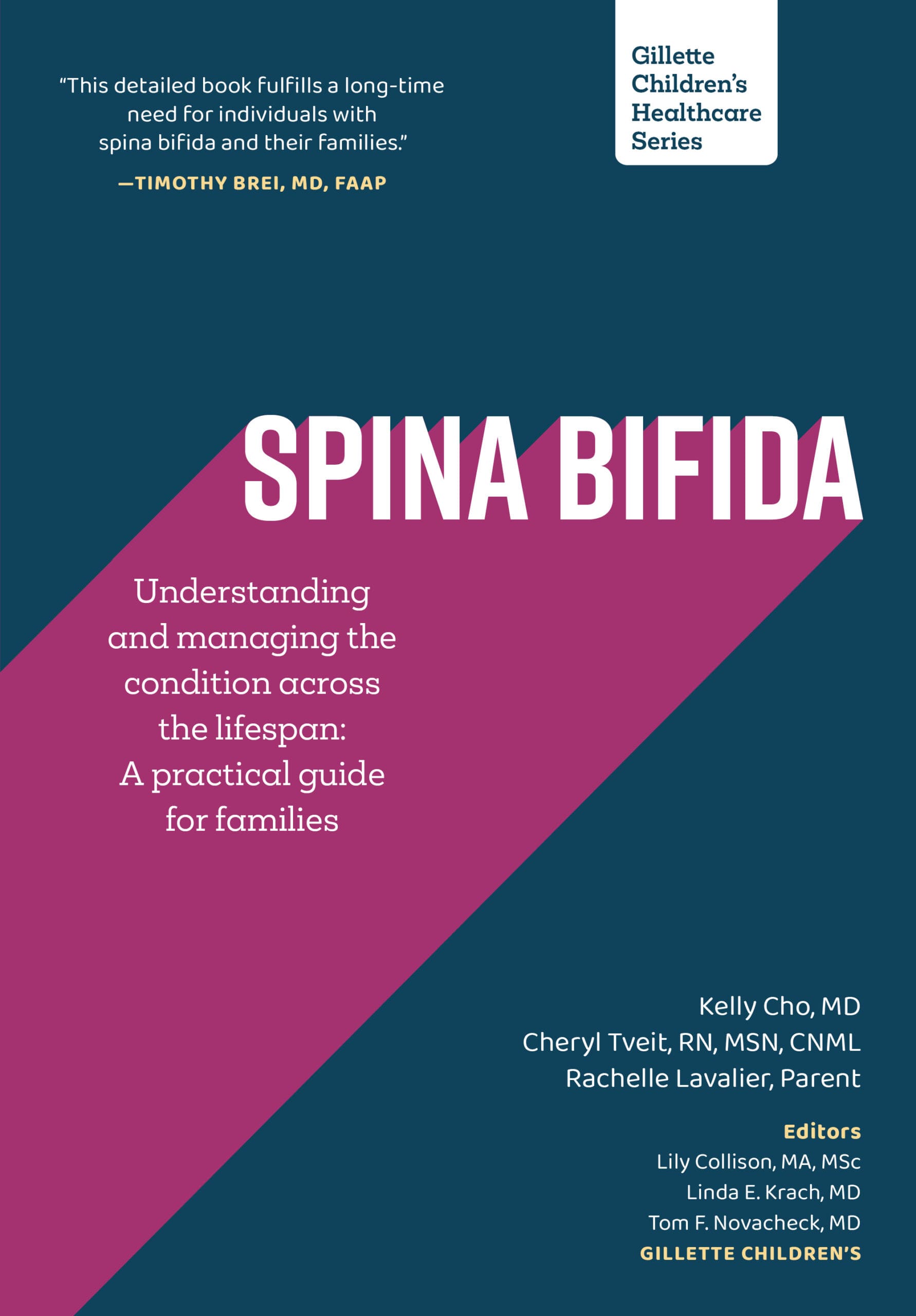
Other titles in the series include:
- Craniosynostosis
- Idiopathic Scoliosis
- Spastic Quadriplegia–Bilateral Cerebral Palsy
- Spastic Diplegia–Bilateral Cerebral Palsy, second edition
- Epilepsy
- Spina Bifida
- Osteogenesis Imperfecta
- Scoliosis: Congenital, Neuromuscular, Syndromic, and Other Causes
Authors and Editors
Series Foreword
Series Introduction
- Cerebral Palsy
1.1. Introduction
1.2. The nervous system
1.3. Causes, risk factors, and prevalence
1.4. Diagnosis
1.5. Function
1.6. Classification based on predominant motor type and topography
1.7. Classification based on functional ability
1.8. The International Classification of Functioning, Disability and Health
Key points Chapter 1
- Spastic Hemiplegia
2.1. Introduction
2.2. The brain injury
2.3. Growth
2.4. Bones, joints, muscles, and movements
With Ariana Peterson and Jean Stout
2.5. Typical hand function and typical walking
2.6. Primary problems
2.7. Secondary problems
2.8. Tertiary problems
2.9. Motor function in individuals with spastic hemiplegia
2.10. Associated problems
Key points Chapter 2
- Management and Treatment of Spastic Hemiplegia to Age 20
3.1. Introduction
3.2. What does best practice look like?
3.3. Overall management philosophy
3.4. Therapies
With Susan Ellerbusch Toavs, Candice Johnson, and Amy Schulz
3.5. The home program
With Candice Johnson and Amy Schulz
3.6. Assistive technology
With Candice Johnson, Kaitlin Lewis, Kathryn Pimentel, and Amy Schulz
3.7. Tone reduction
3.8. Orthopedic surgery
With Tom F. Novacheck, Jean Stout, and Ann Van Heest
3.9. Managing associated problems
3.10. Alternative and complementary treatments
3.11. Community integration, education, independence, and transition
With Tori Bahr
Key points Chapter 3
- The Adult with Spastic Hemiplegia
4.1. Introduction
4.2. Aging in the typical population
4.3. Aging with spastic hemiplegia
4.4. Management and treatment of spastic hemiplegia in adulthood
With Jill Gettings and Lee Schuh
Key points Chapter 4
- Living with Spastic Hemiplegia
- Further reading and research
With Elizabeth R. Boyer
Acknowledgments
Appendices (online)
Appendix 1. Measurement tools
Appendix 2. Scoliosis management
Appendix 3. Positioning
Appendix 4. Exercise and physical activity
Appendix 5. Selective dorsal rhizotomy
Appendix 6. Gait analysis
Appendix 7. Rehabilitation after single-event multilevel surgery
Appendix 8. Epilepsy management
Glossary
References
Index
The quote from Nadia Badawi in the opening pages of Spastic Hemiplegia–Unilateral Cerebral Palsy (part of the Gillette Children's Healthcare Series) stating the book is ‘as relevant to doctors and health professionals as it is to people with cerebral palsy and their families’ sums it up pretty well.
This is a clear, exceptionally well-written tome. As with The Hemiplegia Handbook (a practical guide from Mac Keith Press published in association with HemiHelp in 2011), the present book has been co-written by those with real experience of the condition. Much of the information is in line with American Academy for Cerebral Palsy and Developmental Medicine (AACPDM) resources, as well as national and international consensus statements, such as the three relevant National Institute for Health and Care Excellence (NICE) cerebral palsy guidelines (NG62, NG119, CG145).
It is, to that end, a comprehensive reflection on where we currently stand with our understanding of risk, causation, basic neurology, and the musculoskeletal assessment and management of unilateral cerebral palsy. Though, as ever (and as is recognized in the preface), all clinicians would not entirely agree with everything in the book and as such these are my own personal, subjective ponderings.
Spastic Hemiplegia–Unilateral Cerebral Palsy clearly links basic science to the functional and developmental challenges for children and young people with unilateral cerebral palsy. It has an excellent flow, incorporating the parental voice but also not ignoring the lifelong aspect of the condition. The chapter on living with the condition is particularly powerful and should be compulsory reading for any medical student or clinician. We all learn best from a lived perspective.
From a European perspective, the ‘Spastic Hemiplegia’ in the title seems to superficially ignore those individuals with other unilateral cerebral palsies. Though dystonia is recognized within the book, its particular and marked challenges are not. So much is focussed on the motor aspects that the comorbidities encountered are comparatively underdeveloped. A few sentences on bowel and bladder function underplays an area many individuals and families find one of the greatest barriers for social integration. While a total of two to three pages covers all other clinical, behavioural, and mental health childhood difficulties.
Paradoxically, my main concern is that in its completeness, this textbook understandably wants to be all things for all people. There is some minor repetition (which does enable each section to be considered in isolation), but there is so much information that it can occasionally be overwhelming (in particular those sections focussing on musculoskeletal assessment and intervention). As such the book becomes less approachable and at 340 pages (together with online appendices and 25 pages of references), Spastic Hemiplegia–Unilateral Cerebral Palsy might be a difficult resource to navigate for those who need it most.
But as a clinician, I think it is brilliant. Read it and use it in the clinic to explain movement problems.
For the many families I am privileged to support, they tell me what they really need is a simple and affordable short companion book. One that is primarily focussed on why (mainly ‘why me/why my child?’). A book which lays out what physical, behavioural, developmental, and comorbid challenges and experiences families can expect to see. And perhaps most importantly, how to support their child/adolescent/young adult in coping with these challenges and breaking down the barriers that exist within society. Ideally, it might just be a booklet using the excellent ‘key points’ from each chapter of Spastic Hemiplegia–Unilateral Cerebral Palsy, along with the excellent sections on living with hemiplegia. Then if they have the time and energy (and a good local library), these families might delve into this more comprehensive musculoskeletal review.
Charlie Fairhurst for DMCN: https://onlinelibrary.wiley.com/doi/10.1111/dmcn.16398
Related Books


Improving Quality of Life for Individuals with Cerebral Palsy through Treatment of Gait Impairment
Available as:
Ebook, Paperback