
Gillette Children’s Healthcare Series
The Gillette Children’s Healthcare Series distills medical complexity into clear, actionable roadmaps for childhood-acquired physical and neurological conditions. By bridging the gap between clinical research and daily reality, this definitive collection provides a vital guide for those living with a lifelong condition.
Whether you are an individual navigating your own health journey, a parent or family member supporting a loved one, or a healthcare professional seeking a broader multidisciplinary perspective, this series provides the expert-backed clarity needed to manage the condition with confidence.
Key features:
- Clinical excellence: Delivers detailed medical insights and best-practice evidence-based treatment options.
- Holistic perspective: Explores how each condition impacts development, participation, and overall quality of life.
- Lifelong focus: Provides tailored guidance that evolves alongside the needs of children, adolescents, and adults.
- Empowered outcomes: Equips families with the tools and confidence to partner effectively with healthcare teams for optimal long-term health.
Co-published by Mac Keith Press and Gillette Children’s Healthcare Press, the series is built on a foundation of collaborative expertise. Every book combines evidence-based, best-practice treatments led by medical specialists with the invaluable lived experiences of individuals and families.
Listen to Lily Collison discuss the background to the series on the radio here: https://www.rte.ie/radio/radio1/clips/22501320/
Epilepsy
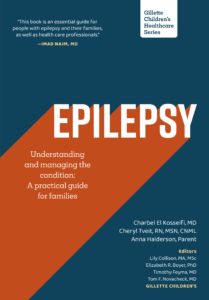
Epilepsy is a condition that can occur at any age. It is often characterized by recurrent, unprovoked seizures. For some individuals, epilepsy will be a lifelong condition, while for others it may be a condition they outgrow. This practical guide explains not only the complexities of epilepsy but also details the evidence-based, best-practice treatments that help manage the condition. It also includes the lived experience of families.
The writing of Epilepsy was led by Dr. Charbel El Kosseifi, Pediatric Neurologist and Epileptologist at Gillette Children’s, a world-renowned center of excellence for the treatment of brain, bone, and movement conditions.
“This book goes beyond relaying information; it involves comfort, guidance, and knowledgeable support and trust—the art of care.” —MARIA ROBERTA CILIO, MD, PHD
“An invaluable resource for anyone seeking to comprehend the complexities of epilepsy.” —COLIN P. DOHERTY, MD
“Finally! A book that truly helps families understand epilepsy. I wish I had this book at the beginning of my journey. It’s a must-read for any family navigating life with epilepsy.” — COLLEEN PETERSON, PARENT
Spastic Hemiplegia–Unilateral Cerebral Palsy
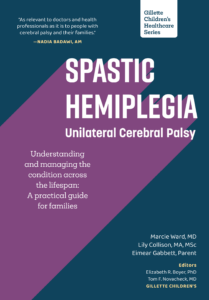
Spastic hemiplegia is a very common subtype of cerebral palsy (CP), and CP itself is the most common cause of childhood-onset physical disability. An estimated 17 million people worldwide have CP. Spastic hemiplegia is also known as unilateral spastic CP or, simply, unilateral CP. Spastic hemiplegia affects the upper and lower limbs of one side of the body. The upper limb is usually more affected than the lower limb. This practical guide addresses spastic hemiplegia across the lifespan and the evidence-based, best-practice treatments. It also includes the lived experience of families.
Spastic hemiplegia affects the upper and lower limbs of one side of the body. The upper limb is usually more affected than the lower limb. This practical guide addresses spastic hemiplegia across the lifespan and the evidence-based, best-practice treatments. It also includes the lived experience of families.
The writing of Spastic Hemiplegia was led by Marcie Ward, MD, Pediatric Rehabilitation Medicine Physician at Gillette Children’s, a world-renowned center of excellence for the treatment of brain, bone, and movement conditions.
“As relevant to doctors and health professionals as it is to people with cerebral palsy and their families.” —NADIA BADAWI, AM
“This book gets my highest recommendation.” —NATHALIE MAITRE, MD, PhD, PARENT
“Wow! This book is the most amazing and comprehensive source of information available for persons with unilateral CP and their families I have ever seen, and it should be required reading for any professionals who care for them.” —DIANE DAMIANO, PhD, FAPTA
“A must-read for all.” —BENJAMIN SHORE, MD, MPH, FRCSC
Spastic Quadriplegia–Bilateral Cerebral Palsy
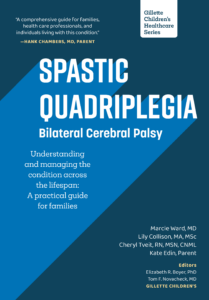
Spastic quadriplegia accounts for about one-fifth of cerebral palsy (CP), and CP itself is the most common cause of childhood-onset physical disability. An estimated 17 million people worldwide have CP. Spastic quadriplegia is also known as bilateral spastic CP or, simply, bilateral CP. Spastic quadriplegia affects all four limbs and the trunk. It is generally a severe form of CP that impacts many aspects of a person’s life. This practical guide addresses both the motor and nonmotor aspects of spastic quadriplegia across the lifespan and their treatment. It also includes the lived experience of families.
The writing of Spastic Quadriplegia was led by Marcie Ward, MD, Pediatric Rehabilitation Medicine Physician at Gillette Children’s, a world-renowned center of excellence for the treatment of brain, bone, and movement conditions.
“A comprehensive guide for families, health care professionals, and individuals living with this condition.” —HANK CHAMBERS, MD, PARENT
“Easy to read and understand … knowledge accessible to all.” —CAROL SHRADER, PARENT
“This book is more than informative; it’s transformative.” —RACHEL BYRNE, BPT, BS
“A compelling must-read.” —IONA NOVAK, AM
Spastic Diplegia–Bilateral Cerebral Palsy 2nd Edition
Spastic diplegia is a very common subtype of cerebral palsy (CP), and CP itself is the most common cause of childhood-onset physical disability. An estimated 17 million people worldwide have CP. Spastic diplegia is also known as bilateral spastic CP or, simply, bilateral CP.
With spastic diplegia, the lower limbs are much more affected than the upper limbs, which frequently show only fine motor impairment. Now in its second edition, this practical guide addresses spastic diplegia across the lifespan and the evidence-based, best-practice treatments. It also includes the lived experience of families.
The writing of Spastic Diplegia was led by Lily Collison, MA, MSc, the parent of a son with spastic diplegia.
“Every important aspect of spastic diplegia is addressed.” —H. KERR GRAHAM, MD, FRACS
“A wonderful and thorough book.” —WILMA VAN DER SLOT, MD, PhD
“This book is an indispensable resource.” —MARK D. PETERSON, PhD, MS, PARENT
“I highly recommend this book for both families and clinicians.” —CATHY MORGAN, PhD
Craniosynostosis
Craniosynostosis is a condition where the bones of an infant’s skull fuse together too early. In most cases, surgery in the first year of life will effectively correct it and the child can go on to expect a typical life. For a minority, craniosynostosis is part of a syndrome, which is a lifelong condition. This practical guide explains how craniosynostosis develops and the evidence-based, best-practice treatments. It also includes the lived experience of families.
The writing of Craniosynostosis was led by Dr. Ruth Barta, MD, Craniofacial and Pediatric Plastic Surgeon at Gillette Children’s, a world-renowned center of excellence for the treatment of brain, bone, and movement conditions.
“One of the most comprehensive and educational books on craniosynostosis.” —WALEED GIBREEL, MD
“The book I wish I had when my son was diagnosed with sagittal craniosynostosis.” —ELAINE L. KINSELLA, PARENT
“A remarkably comprehensive review of all things related to craniosynostosis.” —CHRISTOPHER R. FORREST, MD
Idiopathic Scoliosis
Idiopathic scoliosis is a condition in which, for no known reason, there is an atypical three-dimensional curvature and rotation of the spine. Idiopathic scoliosis is the most common type of scoliosis. For the large majority of people with this condition, no specific intervention is needed. For others, treatment such as bracing or surgery is needed to effectively manage the condition. While diagnosis and treatment can be challenging, individuals with idiopathic scoliosis can expect to lead typical lives. This practical guide explains idiopathic scoliosis and the evidence-based, best-practice treatments. It also includes the lived experience of families.
The writing of Idiopathic Scoliosis was led by Tenner J. Guillaume, MD, Walter H. Truong, MD, and Danielle Harding, PA-C, spine specialists at Gillette Children’s, a world-renowned center of excellence for the treatment of brain, bone, and movement conditions.
“An infinitely readable and well-researched book not only for patients and their families but also for health care providers at all levels.” —BENJAMIN D. ROYE, MD-MPH
“Our daughter was diagnosed with juvenile idiopathic scoliosis right before she started kindergarten, and we were so worried. We wish we had this book during that time as it answers so many questions.”, —AMBER MARLATT, PARENT
“As up-to-date and inclusive as a textbook written for medical professionals while being as easily readable as a novel for children with scoliosis and their families. An indispensable source of comfort for all scoliosis patients.” —MUHARREM YAZICI, MD
Scoliosis: Congenital, Neuromuscular, Syndromic and other Nonidiopathic Types
Approximately 20 percent of all scoliosis cases have a known cause. Scoliosis: Congenital, Neuromuscular, Syndromic and other Nonidiopathic Types explains the condition and includes both the current best-practice treatments and the lived experience of families. It is a companion book to Idiopathic scoliosis, which addresses scoliosis where the cause is unknown.
The writing of this scoliosis book was led by Tenner J. Guillaume, MD, Walter H. Truong, MD, and Danielle Harding, PA-C, spine specialists at Gillette Children’s, a world-renowned center of excellence for the treatment of brain, bone, and movement conditions. This book is part of the Gillette Children’s Healthcare Series, a series of books for families who are looking for clear, comprehensive information. Health care professionals, researchers, educators, students, and extended family members will also benefit from reading it.
“A vital educational resource for patients, their families, and health care professionals alike.”
— BRIAN SNYDER, MD, PhD
“I highly recommend this impactful book for families and professionals working in the field of scoliosis.”
—ANN MARIE SUTTON, PARENT
“This book addresses a complex topic in a thorough but accessible way.”
—JOHN S. VORHIES, MD, FAAOS, FAOA
Spina Bifida
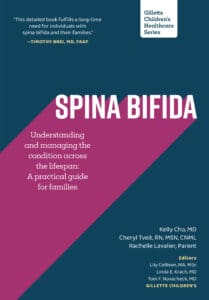
Spina bifida is a neural tube defect that results in incomplete closure of the vertebrae, muscles, and skin that normally surround and protect the spinal cord and nerves. Initial management focuses on restoring protection for the spinal cord and nerves and monitoring the brain closely.
This practical guide addresses the most common type of spina bifida, myelomeningocele, its associated conditions across the lifespan, and the evidence-based best practice treatments. It also includes the lived experience of families. The writing of Spina Bifida was led by Kelly Cho, MD, Pediatric Rehabilitation Medicine Physician at Gillette Children’s, a world-renowned center of excellence for the treatment of brain, bone, and movement conditions.
“This book does a phenomenal job of describing all the diff erent ways the
condition can aff ect a person. It also caters to diff erent audiences—people with
spina bifi da, parents, and those who take care of people with the condition.”
—GRACIE HADLICH, AN ADULT LIVING WITH SPINA BIFIDA
“This handsome resource belongs in the hands of every individual with spina bifi da
and on the shelf of every professional serving this complex population.”
—JONATHAN CASTILLO, MD, MPH, FAAP
“Spina Bifi da is a highly accessible resource that weaves together medical
expertise with practical information for people living with the condition.”
—NIENKE DOSA, MD, MPH
Coming soon…